
Whenever I read the Gospels, I’m always taken a bit aback by how much Apocalyptic — writing about a mysterious coming time when God would come in big ways to right the world’s wrongs — they contain. This is particularly true in years like this one, since our Sunday Gospels have been taken primarily from Mark, the most Apocalyptic-focused of the Gospels, and at this time of year, since the lectionary always takes a turn toward the apocalyptic in the lead up to Advent (which is now just two weeks away! (I’m pretty sure it was just May, but here we are.) And so, I was both surprised and not at all surprised to see a strong Apocalyptic theme in today’s Gospel reading. What stood out to me today, though, is not so much what Jesus encourages his disciples to look for when discerning the times, but what he tells them not to look for. And I think it’s worth considering.
It begins with the disciples admiring the beauty of the newly-renovated Temple, but quickly takes a turn:
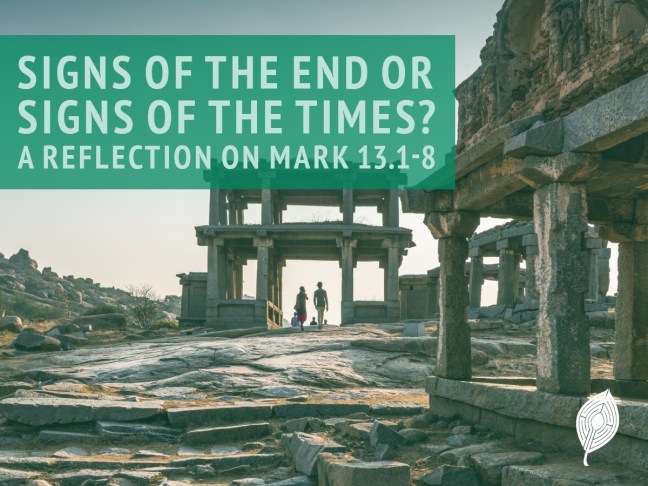
As Jesus came out of the temple, one of his disciples said to him, “Look, Teacher, what large stones and what large buildings!” Then Jesus asked him, “Do you see these great buildings? Not one stone will be left here upon another; all will be thrown down.” (Mark 13.1- 2)
Jesus’ response here doesn’t necessarily need to be apocalyptic in character. He could simply be talking about impermanence, the Roman threat, or urging his disciples once again not to get caught up in the wonders of this world, its empires and kingdoms. (Remember the Temple in question was built as a project of a Persian imperial governor and renovated by — and to the glory of — King Herod the Great, a Roman vassal (he was appointed King by the Roman Senate), who, according to the Gospels, tried to have the infant Jesus murdered.)
But it’s clear that, no matter what Jesus meant by this statement about the Temple, his disciples connected the downfall of the Temple with the Apocalyptic coming of God:
When he was sitting on the Mount of Olives opposite the temple, Peter, James, John, and Andrew asked him privately, “Tell us, when will this be, and what will be the sign that all these things are about to be accomplished?” (13.3-4)
When thinking of ‘the end times’, this is a common response. Despite the fact that Jesus elsewhere tells his disciples explicitly not to concern themselves with such questions (“But about that day and hour no one knows, neither the angels of heaven, nor the Son, but only the Father” (Matthew 24.36)), throughout the ages, many Christians have nonetheless been captivated by it. It’s natural curiosity, mostly. But Jesus isn’t interested in satisfying their curiosity. Instead of telling them what to look out for, he tells them what not to look out for:
Then Jesus began to say to them, “Beware that no one leads you astray. Many will come in my name and say, ‘I am he!’ and they will lead many astray. When you hear of wars and rumours of wars, do not be alarmed; this must take place, but the end is still to come. For nation will rise against nation, and kingdom against kingdom; there will be earthquakes in various places; there will be famines. This is but the beginning of the birth pangs.” (13.5-8)
The disciples ask Jesus what to look out for, and Jesus warns them not to be gullible and be too quick to see ordinary parts of life on Earth as portents of the end. There will be false messiahs who will lead the faithful from the true path, as always. There will be wars, earthquakes, and famines, as always. “Do not be alarmed,” Jesus says. There’s a lot of discussion out there about the meaning of “This must take place.” This translation leans into the idea that these are all part of God’s plan, and in the apocalyptic context, that’s certainly possible here. But the Greek refers more simply to something that cannot not happen. As we know from history and politics, where there are humans, there will be war or and socio-political conflict. As we know from geology, there absolutely will be earthquakes because of plate tectonics. And, likewise, from time to time, whether the result of failed harvests, poor planning, or greed on the part of some, famines will also happen. So none of these things are signs of the end in and of themselves. What they are, though, are the “beginning of the birth pangs.” As Paul puts it:
The creation itself will be set free from its bondage to decay and will obtain the freedom of the glory of the children of God. We know that the whole creation has been groaning in labour pains until now; and not only the creation, but we ourselves, who have the first fruits of the Spirit, groan inwardly while we wait for adoption, the redemption of our bodies. (Romans 8.21-23)
The things we are so quick to point to as signs of the end, according to both Jesus and Paul, are meaningful, but only inasmuch as they remind us that things aren’t as they could or should be in the world. A new world longs to be born, one in which God’s Kingdom — not a kingdom of violence and power, but one of mercy and grace — will at last be visible “on earth as it is in heaven.”
So, as far as Apocalyptic goes, this is almost an anti-Apocalypse. The things we see around us or hear in the news are not signs of the end, but simply manifestations of the world’s suffering under the ways of its rulers, kings, and despots. And yet, this doesn’t mean there won’t be an end, that there isn’t a divine plan. It’s just not for us to know whens or hows of that plan. And yet the Gospel is clear what that ‘new heaven and new earth’ looks like: mercy, compassion, grace, love, and justice. In other words, the true peace of God that is not just the absence of violence but the presence of genuine, giving, and reciprocal relationships.
Reading the news is always anxiety-provoking. We shouldn’t expect it to be otherwise. But as Jesus reminds us, the vicissitudes of life on earth are not to be our focus. Our focus instead is to be on what truly matters, and that is God and the ways of God’s kingdom.
 Matthew Root
One thought on “Signs of the End or Signs of the Times?: A Reflection on Mark 13.1-8”