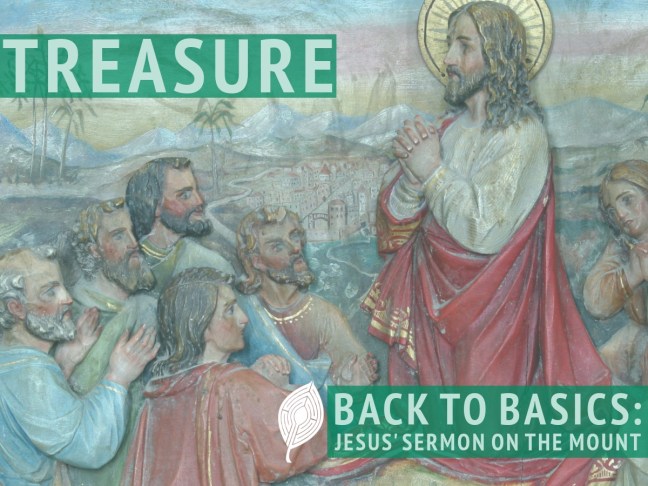
I once knew a man who was a big-time collector of sports cards. He spent thousands of dollars gathering his highly curated collection. But the greater the collection became, the more he started to worry about it. So, he spent hundreds more on insurance plans and security systems. Eventually, it got to the point where he’d never want to be more than a couple hours away from home, in case he got a security notification. In other words, in time, this thing that had once given him joy took over his entire life. I think about this story whenever I read Jesus’ teaching in the Sermon on the Mount about what he calls ‘treasures’. It’s one of Jesus’ simplest teachings, so this will be a short post, but also one of the most challenging.
He starts like this:
Do not store up for yourselves treasures on earth, where moth and rust consume and where thieves break in and steal; but store up for yourselves treasures in heaven, where neither moth nor rust consumes and where thieves do not break in and steal. For where your treasure is, there your heart will be also (Matthew 6.19-21).
There’s an astute detail here. Jesus doesn’t say that our treasure — what we value most — follows our heart, but that our heart follows our treasure. The heart in the New Testament often serves as a parallel to the Greek word nous, which is generally translated ‘mind’, but which is more about perception and interpretation than cognition or thinking (which is covered by the Greek dianoia). When the New Testament uses these words in a technical sense, it’s generally talking about how we understand the world. The heart or mind (nous) can be clear and therefore oriented toward God, seeing the world as God sees. Or, it can be clouded or dysfunctional, leading us astray. Here, Jesus is making the point — and I think it’s a good one — that our interpretation of what we see and experience in the world will always follow our treasure, whatever that treasure may be. If we value money above all else, then we will understand the economy and society as a whole through the lens of making money. If our ultimate value is our ‘nation’ (really whoever we think of as being included in ‘us’), we will see the world entirely through the lens of the thriving and security of our nation. If our ultimate value is pleasure, then again we will see everything through that lens. In other words, everything becomes justifiable to us in order to get, increase, and protect our treasure.
So these words aren’t just a warning against accruing wealth, though they definitely are that. They’re warning us against anything that can get in the way of us and the Kingdom of Heaven, its values, and its ways. This interpretation is supported by what Jesus says next:
The eye is the lamp of the body. So, if your eye is healthy, your whole body will be full of light; but if your eye is unhealthy, your whole body will be full of darkness. If then the light in you is darkness, how great is the darkness! (6.22-23)
This is a bit convoluted since Jesus wasn’t working from a scientific understanding of vision, but the point itself is clear. If our eyes are healthy, we will be able to see properly. And the same is true spiritually. If our heart and mind (nous) is healthy, focused on the right things, we will see the world as God sees it and live accordingly. If not, we won’t. So, we need to be clear about what is it we’re focused on. And if our hearts are focused on our bank accounts, the next high, our personal security, or our national honour as our greatest treasure, they can’t also be focused on love of God and love of neighbour.
Jesus puts it more bluntly a few verses later: “No one can serve two masters; for a slave will either hate the one and love the other, or be devoted to the one and despise the other. You cannot serve God and wealth” (6.24). We can worship at the altar of wealth (or nation or security or pleasure or any number of things), or we can worship God. We can serve these things, or we can serve God. We cannot do both at once. As it happens, this is why the whole notion of ‘Christian nationalism’ is a categorical falsehood. You cannot serve both God and nation any more than you can serve God and wealth simultaneously. Love of nation blinds us to the true meaning of loving our neighbour as ourselves, just as love of wealth does.
So in this section of the Sermon on the Mount, Jesus calls us to question our values and understand what is really at stake. We will always live in service of something. The question is what. And so, the question before us today, and really every day, in every decision, is simple: Where is our treasure?
 Matthew Root
14 thoughts on “Treasure”