
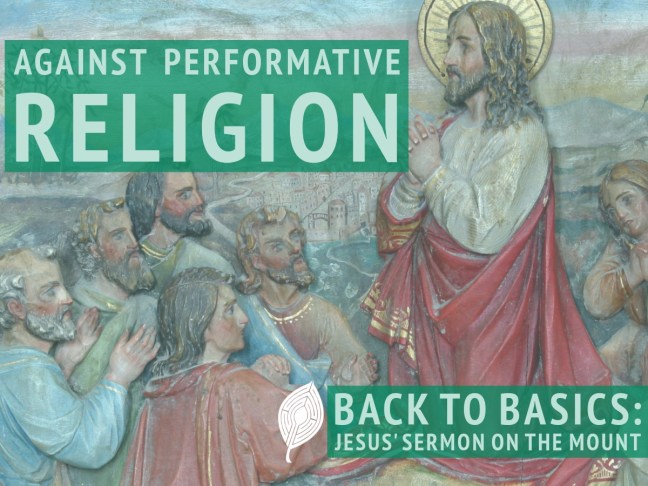
After the Beatitudes and his radicalization of the Law, Jesus turns his attention to questions of personal piety. Today’s post will explore each of these teachings through the primary lens of the common thread among them, and then see how they connect with the other parts of the Sermon on the Mount we’ve studied so far.
Jesus starts this section by explicitly stating his thesis: “Beware of performing your piety before others in order to be seen by them; for then you will have no reward from your Father in heaven” (Matthew 6.1). The then uses alms giving, prayer, and fasting as test cases:
‘So whenever you give alms, do not sound a trumpet before you, as the hypocrites do in the synagogues and in the streets, so that they may be praised by others. Truly I tell you, they have received their reward. But when you give alms, do not let your left hand know what your right hand is doing, so that your alms may be done in secret; and your Father who sees in secret will reward you.
And whenever you pray, do not be like the hypocrites; for they love to stand and pray in the synagogues and at the street corners, so that they may be seen by others. Truly I tell you, they have received their reward. But whenever you pray, go into your room and shut the door and pray to your Father who is in secret; and your Father who sees in secret will reward you. ‘When you are praying, do not heap up empty phrases as the Gentiles do; for they think that they will be heard because of their many words. Do not be like them, for your Father knows what you need before you ask him….
And whenever you fast, do not look dismal, like the hypocrites, for they disfigure their faces so as to show others that they are fasting. Truly I tell you, they have received their reward. But when you fast, put oil on your head and wash your face, so that your fasting may be seen not by others but by your Father who is in secret; and your Father who sees in secret will reward you. (6.2-8, 16-18)
These teachings all test the motivations behind piety: Are we giving charitably because it’s the right thing, or to be seen doing the right thing (or for the tax rebate, or to have our name written in the program or on the side of a building)? Do we pray simply from our hearts, or do we craft our words perfectly to impress in public? Do we make a show of our fasting, or do we hold it as something sacred, just between us and God?
What Jesus is getting at is that our piety is not for public consumption. If it is, then we’ve already gotten the benefit from it we’ve sought. We want to be seen to be pious? Then our long-winded public prayer has done its job — we’ve definitely been noticed. It’s a transaction between us and our audience and that transaction has been completed. God isn’t part of the equation at all. Such questions are of particular importance in contexts where it is seen as socially proper to be faithful. Faith then becomes a question of keeping up appearances and ‘playing the game’ of social gain. (t’s likely this is why Jesus mentions the Gentiles in the teaching on prayer; in Greece and Rome, religion was a civic duty, and political offices and priesthoods were often connected.) But all this is far from the point of religious observance.
If we give to the poor, it’s because doing our part to ensure everyone in the community has the basics they need is a natural outflow of the love and grace of God, not because it makes us look good. If we pray, it’s because we want to offer our praise and thanks to God, and to offer up the concerns of our heart, not because we like being seen to be articulate or passionate. If we fast, it’s because we understand that our appetites can’t always be trusted, not because we want to show off our piety or strenuousness.
There’s an interesting interplay here, where once again Jesus subverts and inverts the way religion is often practiced. What many of us seem to want is a faith that is private in scope — that is, it’s all about me and my personal relationship with God — but public in orientation — we still want to be seen as pious and faithful. But what Jesus teaches is a faith that is public in scope — it includes not only our relationship with God, but also our relationships with ourselves, with our communities, and the whole world — but private in orientation — kept just between us and God, with no witnesses. Our lives are to be a witness to the world, our piety should not. As a seminary professor of mine once put it, railing against Christian ‘bumper sticker culture’: “It’s ‘They’ll know we are Christians by our love, not ‘our accessories!’”
And that’s the thing. Again: Our lives are to be our witness, not our piety. It’s not our public displays, not our good religious personas that matter, but how we actually live, what we actually do ‘outside’ the realm of piety that testifies to our actual piety.
It’s not the way we normally think about the world, but that’s the point. God’s ways are not this world’s ways, and we always need to remember that.
 Matthew Root
12 thoughts on “Against Performative Religion”