
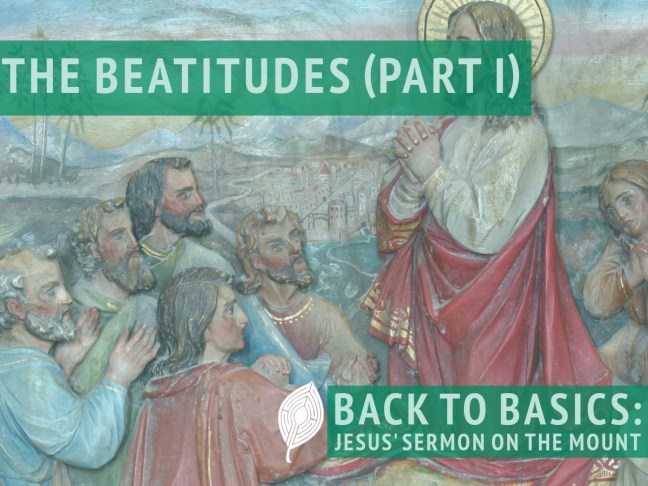
As we saw last time, the first teaching we get from Jesus in his public ministry is “Repent, for the kingdom of heaven has come near!” I’ve written extensively on repentance in the past, but to summarize, to repent is to undergo a change of mind, heart, and disposition such that one begins to see one’s life and the world through God’s eyes. One can think of the Sermon on the Mount, and really all authentic Christian teaching, as a fleshing out of what this means in our actual day-to-day lives. This can clearly be seen in the Sermon’s opening salvo, the Beatitudes. Today, I’ll be introducing Beatitude as a literary genre and blessing as a theological concept, as well as looking at the first three Beatitudes. In the next post, I’ll complete the survey and summarize the teachings.
The Beatitudes are a series of eight (or nine, depending on how you count) blessings. Here they are formalized such that the first half of the statement offers a simple, undefined and unexplored, description of who it is who is blessed, and the second half describes what the blessing entails: “Blessed are the ______, for they shall _______.” This literary form is not unique to Jesus, and has strong parallels in Egyptian, Greek, and Second Temple Jewish Wisdom literature. All of these sources share a basic understanding of what blessing means, and this provides a helpful place to start our thinking on the Beatitudes of Jesus as well. As summarized by Hans Dieter Betz, blessing “designates a state of being that pertains to the gods and can be awarded to humans postmortem,” in which “a deceased person who has been before the court of the gods of the netherworld, who has declared there his innocence,and who has been approved to enter the paradise of [the god], even to become [divine] himself”.* So the term is loaded with eschatological — that is, end-of-life and end-of-age — meaning and therefore does not look at things from the perspective of this world and its categories. In the Judaism of Jesus’ day, it was also strongly apocalyptic — that is, unveiling the presence of divine justice in an unjust world. So, for example, a list of beatitudes from the apocalyptic text 2 Enoch blesses those who “revere the name of the LORD,” “carry out righteous judgment … for the sake of justice,” “clothe the naked,” and “help anyone who has been treated unjustly” (2 Enoch 42.6-14). Blessing is also connected to Wisdom traditions: they are about how to live wisely before God and the world. In the Jewish tradition, this means how to live well in accordance with the Law of Moses. The association of blessing with these three ideas (eschatology, apocalyptic, and wisdom/Law) is important for us to understand because, as we shall see, those who are ‘blessed’ according to Jesus are not the kinds of people who are “#blessed” on social media. Just like repentance itself, blessing means allowing the scales to fall from our eyes and seeing everything through God’s eyes.
Turning now to the Beatitudes of Jesus, they begin with what can be thought of as a thesis statement for the whole section: “Blessed are the poor in spirit, for theirs is the kingdom of heaven” (Matthew 5.3). There’s been a lot of discussion on the meaning of “poor in spirit,” particularly as it’s not a term found elsewhere in the Bible, and since Luke’s version of the text simply states “Blessed are you who are poor” (Luke 6.20). Does Jesus have material poverty in mind, or some kind of spiritual poverty? On the one hand, certainly the Scriptures are hard on the wealthy and have, as Gutierrez popularized it, a “preferential option for the poor.” (As Jesus will put it later in the Gospel according to St Matthew, “It is easier for a camel to go through the eye of a needle than for someone who is rich to enter the kingdom of God” (19.24).) But on the other hand, it is possible for a poor person to be just as greedy, acquisitive, and uncaring as a wealthy person, so there is nothing inherently good or ‘blessed’ about material poverty itself. The best answer — which neither minimizes nor unduly emphasizes material poverty — is, I think, to understand poverty in spirit as the acceptance of the basic human condition. That is, we could paraphrase the beatitude with “Blessed are those who understand that life is naturally full of poverty, deprivation, and desertion.” While this bears a lot of similarity to Buddhism’s First Noble Truth, that life is unsatisfactoriness, it also has strong biblical precedents — and these precedents are from precisely those parts of Isaiah most top of mind in the Gospels’ descriptions of Jesus, such as Isaiah 42 (which we already saw Jesus allude to in the previous post) and 61 (which, in the Gospel according to St. Luke, Jesus takes up as his own personal manifesto):
Here is my servant, whom I uphold, my chosen, in whom my soul delights; I have put my spirit upon him; he will bring forth justice to the nations. He will not cry or lift up his voice, or make it heard in the street; a bruised reed he will not break, and a dimly burning wick he will not quench; he will faithfully bring forth justice. He will not grow faint or be crushed until he has established justice in the earth; and the coastlands wait for his teaching. (Isaiah 42.1-4)
The spirit of the Lord God is upon me, because the Lord has anointed me; he has sent me to bring good news to the oppressed, to bind up the broken-hearted,to proclaim liberty to the captives, and release to the prisoners; to proclaim the year of the Lord’s favour, and the day of vengeance of our God; to comfort all who mourn; to provide for those who mourn in Zion— to give them a garland instead of ashes, the oil of gladness instead of mourning, the mantle of praise instead of a faint spirit. (Isaiah 61.1-3)
Both of these texts insist not only on God’s care for the poor and oppressed, but also God’s solidarity with them: God’s Servant brings good news to the oppressed and binds up the broken-hearted through God’s own humility and humble service.
Bringing this back to Matthew 5.3, as Betz puts it: “Suffering and hardship, conditions that poverty entails, can never simply be called ‘just.’ If, however, such poverty is the general human predicament and if those who are God’s faithful recognize and accept it with humility, such submission deserves ‘merit.’ God, who represents and guarantees justice, will therefore reward such faithfulness (see 5:12).” The nature of the blessing such people receive is described here simply as the Kingdom of Heaven itself. This idea too will get fleshed out in the subsequent Beatitudes.
The association I’m suggesting between the Beatitudes and the latter oracles of Isaiah is further supported by the second Beatitude, “Blessed are those who mourn, for they will be comforted” (Matthew 5.4), which reworks Isaiah 61.2: “…to comfort all who mourn.” As the book of Lamentations reminds us, grief is a particularly apt example of that poverty, deprivation, and desertion the first Beatitude understands to be the basic human condition. Mourning is the only proper response when we see the state of the world, whether for faithful Judahites exiled to Babylon following the destruction of their country, city, and temple, or whether for us today as we see increased threats from wars, authoritarianism, and environmental devastation. The faithful response to what we see in the world is not denial or spiritual bypassing, but to accept and lament what is. The blessing received by those who mourn is comfort. This isn’t a Job-like restoration of good fortune, but comfort and solidarity in what has been lost. There will be trouble in the world, there will be loss, but there is comfort too.
The third Beatitude blesses the ‘meek’, another category of people strongly associated with both Isaiah and the Wisdom tradition. There is no better description of meekness than Psalm 42 (”a bruised reed he will not break, and a dimly burning wick he will not quench”). And the book of James highlights it in its description of Christian wisdom: “Who is wise and understanding among you? Show by your good life that your works are done with gentleness born of wisdom” (James 3.13). It is not only an important part of Jesus’ teaching here, but is the foundation of Matthew’s christology. It’s nothing other than the living out of that poverty of spirit that was the focus of the first Beatitude: Recognizing that pain, suffering, loss, and grief will come to everyone — rich, poor, powerful, or oppressed — the meek person chooses to live life with an open heart and open hand, with equanimity, grace, and gentleness. The reward described for such people is perhaps the most shocking and controversial: they “shall inherit the earth.” This idea is part of the ‘great reversal’ that is part-and-parcel with apocalyptic literature. It envisions a future state in which this world’s ‘losers’ become the winners, in reward for their perseverance and faithfulness. But there are two important things to note here. First, Jesus ties this reversal not to a social, economic, political, or religious identity, but to an ethic. It’s not for those who are on the ‘right’ team, so to speak, but for those who embody the humble way of God’s Kingdom as much as possible in this world. And second, the ultimate fulfillment of God’s Kingdom is a situation in which there are no winners or losers, in which there is no longer need for a great reversal. The point is not to perpetuate injustice by creating a new set of oppressors and oppressed, but to correct the injustice of this world through God’s justice. And in order for this to happen, it must be for those who already live in the ways of God’s justice, which is defined as humility, gentleness, mercy, and grace — meekness.
The rest of the Beatitudes will have to wait until next time. But already we can see the three major themes of Beatitude as a genre at work: they are eschatological, dealing with a future reward for present faithfulness, they are apocalyptic, insisting on the justice of God in an unjust world, and they are about wisdom, how to live rightly in the world. The ethic they reveal, at least so far, is one of radical acceptance of reality, equanimity, lamentation, and humility. It’s hard not to comment on just how far this is from the clanging cymbals of so much of what passes for Christianity today! As always, returning to the teachings of Jesus is a wake-up call. These are difficult teachings that cut right through our current cultural divides as much as they cut across the religious and political divides of Jesus’ day. They present a strong challenge to everyone, no matter where one is on the political spectrum or socio-economic ladder. That’s the point. They’re not of ‘this’ world. And it tells us that it’s impossible to bring God’s Kingdom on Earth through power plays, political machination, or domination. That would be a contradiction in terms. It’s just not how it works. And none of that is our calling or vocation. What we are called to do is to live out the ways of God’s Kingdom within the context of this world’s kingdoms. And, as far as the Beatitudes we’ve looked at so far are concerned, that means, living justly, with humility, gentleness, mercy, and grace.
 Matthew Root
17 thoughts on “The Beatitudes (Part I)”