
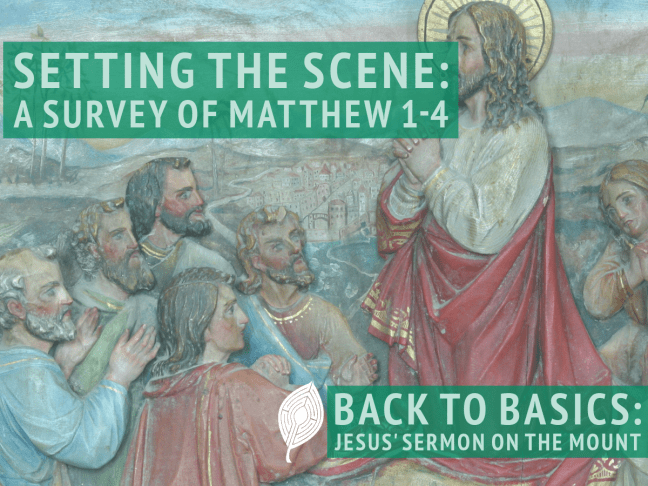
This series is about the Sermon on the Mount, Jesus’ first major teaching discourse, which can be found Matthew 5-7. But before we get into that, it’s important to see how Matthew sets the stage for it. And that’s what today’s post is about.
The Gospel according to St Matthew begins — rather inauspiciously for most modern readers! — with a genealogy (1.1-17). I won’t go into it into too much detail here (but see my post on biblical genealogies if you’d like a bit more information), but a couple things are worth noting. First, Matthew states right at the start that Jesus is the Messiah. There is no ‘messianic secret’ here — at least not for Matthew’s readers. And everything that comes after is therefore meant to say something about this Messiahship. For example, he traces Jesus’ line from Abraham through King David, establishing Jesus’ Jewish and royal pedigrees. (This contrasts with Luke’s genealogy, which traces the lines to Adam, setting up the contrast of Jesus as the ‘new Adam’.) It also subverts expectations of ancient Jewish genealogy by including four women, all of whom are ‘tainted’ in some way by the standards of first century Judaism, through sin, scandal, or connection to Gentiles. Not only does Matthew’s genealogy not hide these figures, but it goes out if its way to bring them up. So already in this genealogy, Matthew is setting up his story — and Jesus’ status as the Messiah — to be about subverting the expectations of ‘good religion’, especially when it comes to ideas of exclusivity, purity culture, and keeping up appearances.
The theme of messiness continues with Jesus’ birth narrative, which features a scandalous (if miraculous) conception (1.18-25), visits from Gentile practitioners of divination who run afoul of the ‘rightful’, Jewish political authorities (2.1-12), and an escape from those authorities into Egypt, a land associated not only with Gentiles but also with slavery and captivity (2.13-23). Again, for many in religious authority, this inauspicious beginning would have been enough to disqualify Jesus from any claim to be chosen by God. But for Matthew’s Gospel, this is part of the point.
Then comes the story of John the Baptist (3.1-17). John often gets sidelined today as a minor figure, but he was anything but in the ancient world. There were still significant pockets of disciples of John well into the second century, and to this day followers of a faith called Mandaeism still claim John as the final and greatest prophet. In a sense, John was the elephant in the room in first century Judaism and Christianity, so it’s no wonder the Gospels spend so much time weaving him into the Jesus narrative. Here, John’s message is summarized by the words, “Repent, for the kingdom of heaven has come near!” (3.2), and his ministry is described as one of baptism following the confession of sins (3.6). He also runs into conflict with the Pharisees and Sadducees, exhorting them to “Bear fruit worthy of repentance” (3.7-10). In this brief description of John’s message, we see a preview of Jesus’ teachings and the conflicts that will hang over his ministry: an exhortation both to repent and to live a life reflective of that repentance, and an insistence that the religious authorities are in as much need of this as everyone else, that the things they care about — ethnic, legal, or ritual purity — have nothing to do with being right with God.
The two men meet at Jesus’ baptism. John recognizes Jesus and at first refuses to baptize him, but Jesus insists, “to fulfill all righteousness” (3.15). These words, together with Jesus’ act of humility in submitting to John’s ministry here, connect Jesus’ baptism to the oracle of Isaiah 42 and its vision of ‘the Suffering Servant’. The scene ends with the climactic revelation of the Trinity in which the Spirit descends on Jesus and the voice of the Father acknowledges him as God’s Son and Beloved (3.16-17).
Immediately after the baptism, Jesus is compelled by the Holy Spirit into the wilderness, where he is tempted by Satan (4.1-11). The temptations essentially attempt to get Jesus to step into his vocation in the wrong way, abusing his power for self-serving ends, showing off his entitlement and privilege, and ruling over the world’s kingdoms on the world’s terms instead of ushering in God’s Kingdom. It is only after successfully resisting these temptations that Jesus’ public ministry can begin. The first words of teaching we get from Jesus are the same ones we heard from John, “Repent, for the kingdom of heaven has come near!” (4.17). Jesus then calls his first disciples and starts his ministry in earnest. By the ending of chapter 4, we see that his fame is growing:
Jesus went throughout Galilee, teaching in their synagogues and proclaiming the good news of the kingdom and curing every disease and every sickness among the people. So his fame spread throughout all Syria, and they brought to him all the sick, those who were afflicted with various diseases and pains, demoniacs, epileptics, and paralytics, and he cured them. And great crowds followed him from Galilee, the Decapolis, Jerusalem, Judea, and from beyond the Jordan. (4.23-25)
It’s at this point the text transitions from what has been so far a quickly-moving narrative to the three whole chapters of teaching we call the Sermon on the Mount.
With all this survey in mind, it’s time to zoom out and look at how these four chapters set up the Sermon to come.
What stands out the most to me is the way Matthew plays with religious expectation. He states right at the start the Jesus is the Messiah, but then presents a genealogy that would both support and undermine this claim in the eyes of many of his contemporaries. Similarly, the birth narrative raises more questions about Jesus’ messianic bona fides than it answers. The first teachings of both John and Jesus are a call to repentance, but this is not just for the ‘rabble’, but is directed just as much to those widely understood to be ‘righteous’ or ‘pure’. A heavenly voice acclaims Jesus as God’s Son and Beloved, but this is tied not to glory but to humility. And the stand-off in the wilderness shows that doing the right thing in the wrong way is not only wrong, but of the devil himself.
At every step, we get the sense that this is a religious, and specifically Jewish, story that will challenge the assumptions of religion at every turn.
This is how Matthew sets the scene for the Sermon on the Mount. In the next few weeks, we’ll see how — and if — these themes are developed in Jesus’ teaching.
 Matthew Root
I am looking forward to this series!
LikeLike