
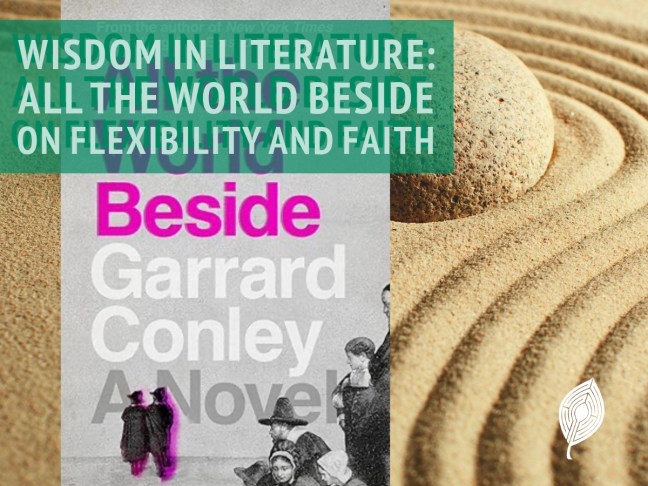
As I mentioned last week, a surprising number of the books I’ve read in the past year or so that deal with spiritual themes do so while also exploring themes of gender and sexuality. In that post, I explored that trend through the idea of the arena, at how these issues that are so controversial and divisive in the world and Church today heighten the dramatic challenge faith requires for those whose natures put them in the frey. A writer who knows this tension better than many is Garrard Conley, best known for his 2016 memoir, Boy Erased, which recounts his damaging experiences undergoing conversion therapy at the insistence of his fundamentalist parents. This year, he released a novel, All the World Beside, which explores these themes in a rather different way, through imagining the thought processes of early eighteenth century Massachusetts Puritans trying to understand their queerness. What I thought Conley did a wonderful job of doing here is demonstrate how religious belief, no matter how intentionally conservative it may be, has the power both to uplift and tear down. So often, it’s not ‘religion’ that’s the barrier to queer expression, but one’s attitude towards it. The question is, do we hold the worldview that conventionally goes along with the tenets of our faith with a clenched fist, or with an open hand?
In this book, we meet Arthur, a small town physician who finds himself irresistibly drawn to Nathaniel, a minister whose revivalist preaching led to the founding of their community, and Ezekiel, Nathaniel’s infant son whom the two men, in their pre-scientific ways, believe to have been the product of their coupling as much as Nathaniel’s with his wife. The question these circumstances pose these two men, learned by the standards of their day and very intelligent, but lacking scientific knowledge and immersed in a restrictive worldview that placed as much stock in the devil as in God, is how to make sense of it all: How to understand themselves, their relationship, their marriages, and Ezekiel within their belief system.
Nathaniel is convinced the boy is essentially tainted by their sin, and becomes afraid both for him and of him. These fears are exacerbated when, as Ezekiel grows, he is drawn towards ‘feminine’ things, like ribbons and softness and anything that shines, and is seemingly unable to learn to read or memorize Scripture, or at times even speak. What greater judgement could there be on a minister than to have a son robbed of all the faculties required to follow in his footsteps! Arthur, however, takes a different view, and tries to take the boy under his wing, spending time with him and nurturing his artistic talents.
The same dynamic plays out within the push and pull of Arthur and Nathaniel’s relationship, which is mostly ‘on ice’ throughout the book, with Nathaniel allowing only the most formal contact. But after one rare moment of intimacy between them, they get into a theological argument. Nathaniel despairs that Ezekiel will be ‘like them’, and Arthur asks whether that would be such a bad thing for him to be like his father deep down: “I would very much like to meet young Nathaniel,” he remarks, “the boy who sits with his mother all day and dreams. He sounds delightful.” This he contrasts favourably to Nathaniel’s present rigidly constrained state, “Angry, embittered, lonely — never more than a child, really.” He then points to the blessed and covenanted, queer-coded friendship between David and Jonathan as a Scriptural example that points to a different possibility for men like them. But Nathaniel cannot accept even the possibility of such an idea: “Do not search the holy book for mirrors of ourselves. That is unwise and sinful. What we have done — what we are, whatever this is — it is altogether different, and we shall have to live with it.” And, “God did not create this. It is not natural. It is not divine. It is nothing but what it is, here in this bed.”
Over the now quite long history of this blog, I’ve returned time and time again to the idea of “a faith that works.” And a faith that works is a faith that promotes our growth, maturity, and personhood, made manifest in the bearing of good fruit in the world. The corollary of this is that any faith that would keep us as children, and which bears bad fruit in the world, is insufficient, damaging, and not of God. Our religious traditions contain the seeds of both approaches. Our faith as Christians can be rigid, unbending, and insistent on the world fitting into its narrow, comfortable and conventional parameters. Or it can be flexible, creative, and willing to withhold judgement upon the world and its refusal to be constrained by our rules.
This is the line that divides Nathaniel and Arthur. In the midst of their argument, Arthur concludes, “It is your pride which makes you think you can control the method and delivery of God’s grace.” I have to admit this hit home for me and my own experiences. Sometimes the very thing you are fighting with all your heart, mind, and strength is the very grace God is offering.
The choice of which path to take is ours to make. And I for one, am increasingly convinced a flexible, creative, open-hearted faith is more reflective of the teachings of the Scriptures and the example of Christ than the other path. And I’m grateful to Garrard Conley for exploring these themes so wonderfully in his novel.
 Matthew Root
One thought on “Wisdom IN Literature: All the World Beside on Flexibility and Faith”