
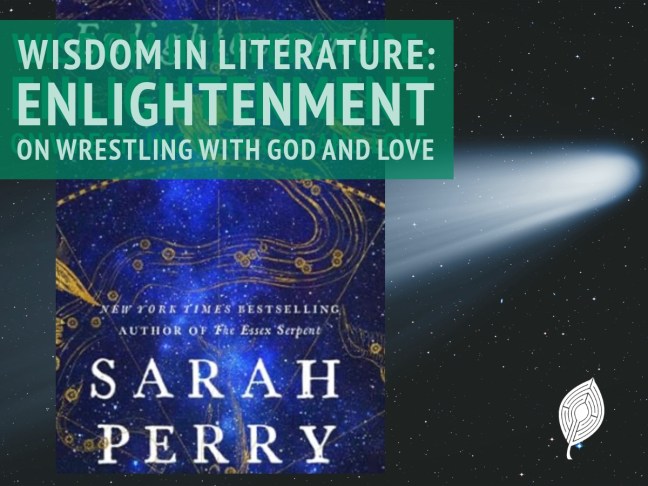
Several of the books I’m bringing to this series this year involve queer themes. This isn’t because of any particular agenda, but because these books often by their very nature deal with faith in a serious way. For these authors or characters, Christianity is not a comfortable old slipper that fits easily on the soul, but something that must be confronted and wrestled with in the most intimate ways. This is, as it happens, why so many queer Christians end up in more traditional or conservative theological environments: They need a theology and tradition big enough and robust enough to face what they’re dealing with. And this is true whether they are fighting their queerness or embracing it.
The novel I’ve read recently — and perhaps ever — that best captures this truth is Sarah Perry’s recent release Enlightenment, which is as I write this in the running for 2024 Booker Prize (one of the highest honours in English-language literature). It’s a strange book that is in many ways anachronistic: In its lush writing no less than the profound spiritual concerns of its characters it really doesn’t feel like something out of this century. But these were for me the parts of the book where it really shines. Its main character Thomas, a middle aged local newspaper columnist, who splits his life and heart between the strict evangelical chapel in which he was raised and London’s gay subculture of the late 1990s, reflects towards the beginning of the book:
Do you think you lose your faith because your faith does not want you? That would be easy. My life would have been a happier one. For all these years there have been two fires in me, and neither puts the other out. So this is how I make sense of it: In London I live that part of my life and I never feel it to be a sin. And on the train between Liverpool Street and Aldleigh, I set it aside, and come to Bethesda [Chapel] and I am another man.
While I never bifurcated my life in the way the character does here, the passage is still very relatable: the twin fires which only seem to make each other burn brighter rather than snuffing the other out.
This idea reminds me of the famous speech by Teddy Roosevelt about the arena:
It is not the critic who counts; not the man who points out how the strong man stumbles, or where the doer of deeds could have done them better. The credit belongs to the man who is actually in the arena, whose face is marred by dust and sweat and blood; who strives valiantly; who errs, who comes short again and again, because there is no effort without error and shortcoming; but who does actually strive to do the deeds; who knows great enthusiasms, the great devotions; who spends himself in a worthy cause; who at the best knows in the end the triumph of high achievement, and who at the worst, if he fails, at least fails while daring greatly, so that his place shall never be with those cold and timid souls who neither know victory nor defeat. (Theodore Roosevelt, “The Man in the Arena,” April 23, 1910).
Say what one will about queer people of faith, but — in a world where very few people do anything that takes effort or inconvenience — we are, if nothing else, in the arena, and have been most of our lives. This is what makes it all the more tragic when Thomas is outed by a busybody on the fringes of chapel life. In an instant she reduces all his decades in the arena into something scandalous and ridiculous, and he leaves the community to which he’s dedicated his life in disgrace.
Reflecting later on the fuller scope of his life, he says:
[I]t’s true I’ve only rarely been happy, and perhaps more often been sad. But I have been content. I have lived. I have felt everything available to me: I’ve been faithless, devout, indifferent, ardent, diligent, and careless; full of hope and disappointment, bewildered by time and fate or confused by providence — and all of it ticking through me while the pendulum of my life loses amplitude by the hour.
Irrespective of the particular battles we’re asked to fight and crosses we’re asked to bear, this is the best all people of true faith can really hope for. In my mid-twenties, I made the comment — which I stand by to this day — that I didn’t trust Christians who hadn’t suffered. It’s simply too easy to pass judgement on others when everything has worked out for you; and, generally speaking, the loftier the place of judgement, the greater they fall when life goes sideways for them, as it inevitably does for everyone.
In what is one of the wisest and truest assessments of the life of faith I’ve encountered, Thomas concludes:
Real humility is submitting with wonder and gratitude to being loved — real wisdom is submitting with wonder and gratitude to being loved …. Well: that’s a responsibility and probably a terrible one, and I can’t help you with it. You must work out your own salvation with fear and trembling, and let me work out mine.
This is again the most we can all ask for on this side of Paradise. We all have our crosses to bear — of personality, experiences, proclivities, relationships, health, and on and on. It is not for us to judge how our brothers and sisters in Christ are bearing theirs; we really only have enough capacity to carry our own cross with fear and trembling, but also with as much joy and love as we can.
For me that it is the real message of this wonderful book, and it’s one I hope we can all take to heart.
 Matthew Root
One thought on “Wisdom IN Literature: Enlightenment on Wrestling with God and Love”