
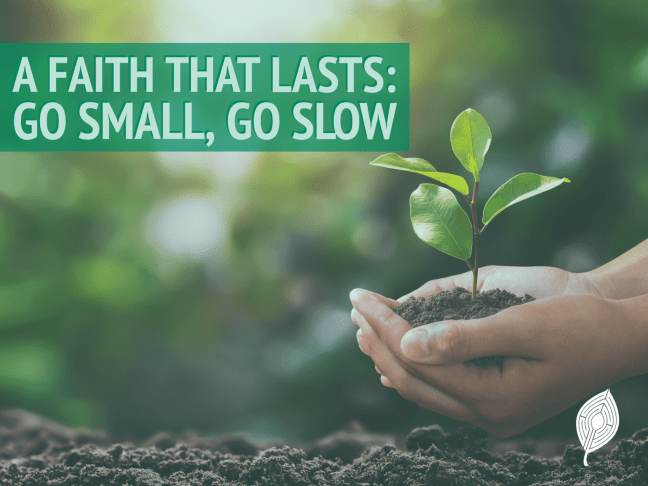
We live in a “Go big or go home” society. We are transfixed by tales of overnight success, maximum growth, and record profits. But this type of success has a tendency to be fleeting. The business world is full of stories of rapid expansion gone wrong. (Target infamously expanded into Canada without bringing its own brands or establishing solid supply chains, opening to near-empty stores and retreating from the market within two years.) Stories of more durable success are rarely as exciting because they tend to be about slow and strategic growth. Our society may want fireworks, but it’s the warm hearth that will keep a business — and a life — going for the long haul. This is why permaculture design has a strong preference for slow growth and small, incremental change, which is the principle we’ll be exploring today.
David Holmgren explains the preference for small-scale, slow-growing systems as follows:
Small and slow systems are easier to maintain than big ones, make better use of local resources, and produce more sustainable outcomes.Systems should be designed to perform functions at the smallest scale that is practical and energy-efficient for that function. Human scale and capacity should be the yardstick for a humane, democratic and sustainable society.*
Holmgren’s preferred example is how fast-growing trees tend to be short-lived; thought of in terms of long-term yields, forestry would be better off investing in slower-growing species, but are often too impatient to take this approach.
This connection between small and slow growth and sustainability can be found throughout nature. When systems grow too quickly, something is normally wrong. I’ve previously used the example of cancer on the cellular level, but on the macro human level, we also see this with the medical condition known as acromegaly, caused by the presence of too much growth hormone. In addition to simply growing ‘too large’ to function easily in society, this condition is associated with many chronic health problems, including diabetes, sleep apnea, cardiovascular problems (including cardiomyopathy), osteoarthritis, problems (including fractures) of the spine, and increased rates of cancers. Again, while growth is generally a good thing, out-of-control growth is not.
Permaculture designers express the principle of slow growth in small systems in a few ways. First, there is the principle of starting small. As Tim Sonder explains it: “start small, get it under control and then slowly expand the perimeter; don’t take on too much too quickly, as you are likely to be overwhelmed.” A second approach, which will already be familiar to many of us, is the ‘80/20 Principle’, which states that eighty percent of the benefit will come from twenty percent of the effort. Irrespective of the exact numbers, the point is that it’s often small changes that have the biggest impact. This is connected to a third application of the ‘start small’ mentality, which is to pilot changes on a small scale before implementing them through a whole system. What all of these have in common is that small, incremental changes give us a greater opportunity to observe their impacts and change course if need be.
These ideas work as well in our personal and collective lives of faith too:
- Starting Small: One of the greatest temptations for people who become newly excited about their spirituality or a new faith community to take on too much too soon, whether that’s starting off with hour-long meditation sessions right off the bat, or wanting to join every ministry in a church. But this can be harmful to their spiritual health, either through burning out — taking on more than they can sustainably carry — or flaming out — taking on more than they are equipped to do. If we want to build a faith that lasts, it’s important to be patient with ourselves and start small and build incrementally from there.
- 80/20 Principle: Here we look for what small changes we can implement that might have an outsize impact. One example of this for me that I’ve used at various times has been developing prayer triggers. Once, when my job involved answering phones, something that has long been a source of anxiety for me, I used the sound of the phone ringing as a trigger for me to pray ‘Lord have mercy’. That not only helped to reduce my anxiety but also helped to integrate my faith more deeply into all aspects of my life. Similarly, a few years ago I started using specific locations in my running route (a beautiful building, a pretty path, or a park filled with trees) as a trigger for prayer, transforming something practical like exercise into an opportunity to encounter the transcendent all around me. These bullet prayers cost me nothing, yet provided a huge positive shift in my spirituality.
- Pilot Changes: The best example I can think of this was something implemented by one of the churches in my area a few years ago. Rather than investing a lot of time and effort into major initiatives and ministries, they took on a “try everything once” approach. Essentially they piloted every idea for ministry, outreach, or community building that someone had, but in a small, cost-limited way. This was brilliant because instead of creating a culture of fear of failure it opened people up to creativity. They took the budget they might have used to fund one or two major initiatives, without knowing how they’d work or be received, to try a dozen different ideas. Those that were successes they continued; those that didn’t work, they simply chalked up to learning experience and move on to the next idea.
So then, starting small and going slow can be an effective way to make changes in the life of faith. It lowers the stakes of trying new things and looks to maximize the benefit while limiting the resources needed. And after all, good things come in small packages. As Jesus himself taught, “The kingdom of heaven is like a mustard seed that someone took and sowed in his field; it is the smallest of all the seeds, but when it has grown it is the greatest of shrubs and becomes a tree, so that the birds of the air come and make nests in its branches” (Matthew 13.31-32).
* See the series bibliography for more details.
 Matthew Root
2 thoughts on “A Faith that Lasts: Go Small, Go Slow”