
Forgiveness is at the heart of the Christian message. It’s also an idea that’s become very controversial and a matter of discussion and debate in society at large (and not without reason). Forgiveness was also a contentious topic in Jesus’ day, as, then as now, people wanted hard and fast rules about it. But Jesus, unsurprisingly, doesn’t take a legalistic approach to it. Today’s Gospel reading features a conversation between Jesus and Peter about this, and it’s worth looking at in greater detail today.
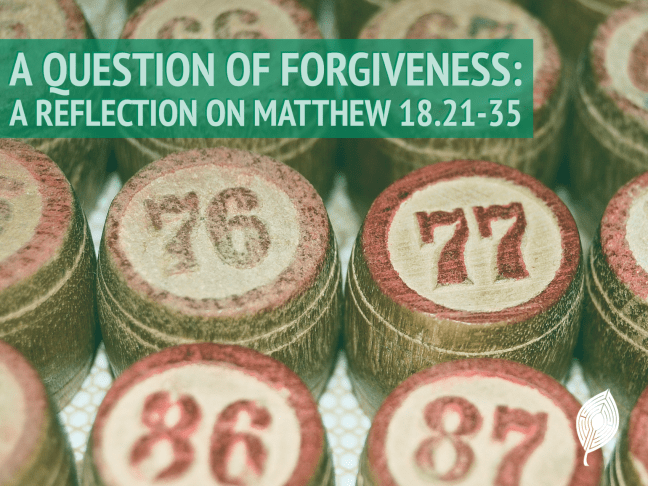
The passage comes at the end of a lengthy teaching session precipitated by the disciples arguing about their own greatness. This sermon covers a lot of ground, including humility, not being a stumbling block to others or oneself, the preciousness of every single person in God’s eyes, and how to deal with conflict in the community of faith. At this point, Peter interrupts him with a question: “Lord, if another member of the church sins against me, how often should I forgive? As many as seven times?” Jesus answers, “Not seven times, but, I tell you, seventy-seven times” (Matthew 18.21-22). The numbers here may seem random, but both Peter and Jesus are playing on Jewish number symbolism of the day, in which seven symbolized perfection. The question essentially is whether forgiving seven times means forgiving perfectly. Jesus replies by doubling the idea of seven, saying that one needs to forgive seventy-seven times: If you want to forgive perfectly, then forgiveness comes without limit. The symbolic nature of these numbers is demonstrated by an interesting fun-house-mirror parallel in Genesis 4.24: “If Cain is avenged sevenfold, truly Lamech seventy-sevenfold.” There, it is perfect vengeance that is called for; but here, it is forgiveness.
Jesus expands on this through a parable:
For this reason the kingdom of heaven may be compared to a king who wished to settle accounts with his slaves. When he began the reckoning, one who owed him ten thousand talents was brought to him; and, as he could not pay, his lord ordered him to be sold, together with his wife and children and all his possessions, and payment to be made. So the slave fell on his knees before him, saying, ‘Have patience with me, and I will pay you everything.’ And out of pity for him, the lord of that slave released him and forgave him the debt. But that same slave, as he went out, came upon one of his fellow slaves who owed him a hundred denarii; and seizing him by the throat, he said, ‘Pay what you owe.’ Then his fellow slave fell down and pleaded with him, ‘Have patience with me, and I will pay you.’ But he refused; then he went and threw him into prison until he would pay the debt. When his fellow slaves saw what had happened, they were greatly distressed, and they went and reported to their lord all that had taken place. Then his lord summoned him and said to him, ‘You wicked slave! I forgave you all that debt because you pleaded with me. Should you not have had mercy on your fellow slave, as I had mercy on you?’ And in anger his lord handed him over to be tortured until he would pay his entire debt. So my heavenly Father will also do to every one of you, if you do not forgive your brother or sister from your heart. (18.23-35)
The parable begins in hyperbole. A slave is found to owe a king ten thousand talents — so vast a sum that it would take several lifetimes to accumulate — and clearly has no way of paying it back. The expected punishment for defaulting on debts was to be sold, with one’s family, in an attempt to recoup some of what is owed. But the servant begs for a chance to make things right, and the king responds by not only sparing him immediate punishment, but going so far as to cancel the extraordinary debt. But the slave has either not understood the lesson of his forgiveness or doesn’t trust it. So he goes out and demands that all his debtors pay him back immediately in full. And when they ask for leniency, he shows no mercy. The king finds out and is irate that this debtor, shown so much mercy, refused to show mercy and forgive his own, far less egregious debtors.
Unsurprisingly, then, what we have here is yet another example of what I’ve elsewhere called God’s Economy, in which we receive in order to give what we’ve received to others. We are shown love, so we love others. We receive compassion in our own problems, so we offer compassion to others in theirs. We are granted forgiveness of our sins — the ways we fall short in our relationships — and so we grant forgiveness to others for theirs. This ‘pay-it-forward’ way of being is the antithesis of legalism and so runs counter to the ways of the world (even those belonging to organized religion that mask themselves as the ways of God).
Legalism has remained in the world, even in the religious world, despite how it runs so opposite to the way of Jesus because, as hard as it is, it’s also easy. We like to know where we stand, to be able to judge ourselves against others and see how we measure up. God’s economy robs us of these signs and that’s hard for the human psyche to deal with. But legalism never leads to anything good or godly, and remains an enemy of God’s ways. God’s economy strips us bare of pretense, pretension, and our hierarchies of righteous and unrighteous, but it is the open and expansive way, and the way that allows us to truly be ourselves and relate honestly to others, one to one, as equals before each other and before God.
 Matthew Root
9 thoughts on “A Question of Forgiveness: A Reflection on Matthew 18.21-35”