
[This series explores the way some of my favourite novels engage with spiritual things. As much as I will try to avoid discussing major plot points, I will be using quotes from the novels and be discussing how they fit generally into the story. So please take this as a spoiler warning.]
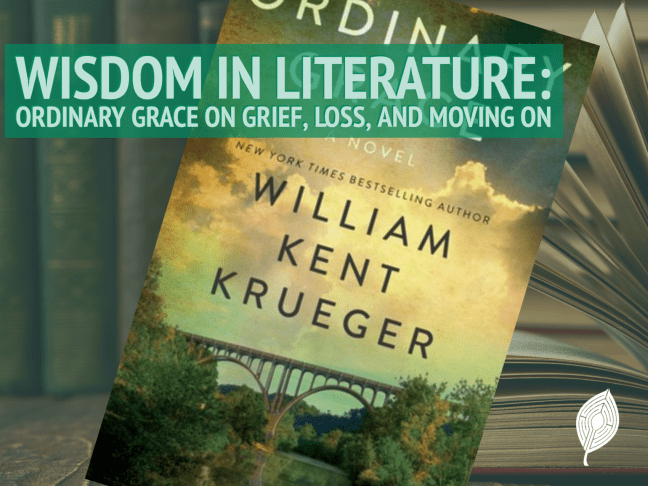
Without a doubt, the biggest question people come to spiritual traditions with today is the problem of pain and suffering. Why is life in this ‘good’ world so hard, and filled with so much, often random and inexplicable, pain? Nowhere have I seen this handled more empathetically than in William Kent Kreuger’s 2013 novel, Ordinary Grace.
Ordinary Grace tells the story of one awful Summer in a small midwestern town, which comes to a head in the disappearance of the Methodist minister’s daughter, the sister of the book’s narrator. Much of the book traces the slow erosion of the hope-filled, ‘American Dream’ optimism of 1961 as the hits just keep on coming for the community and the toll of grief and loss mounts. A pall descends on the whole town, unsure of what to do with all their grief. But the climax of the book — surprisingly for a book published in 2013! — comes in the form of the sermon the minister gives following the discovery of his daughter’s body. He begins with an affirmation of God’s presence, the ‘God-with-us’ at the heart of Christian gospel:
God never promised us an easy life. He never promised that we wouldn’t suffer, that we wouldn’t feel despair and loneliness and confusion and desperation. What he did promise was that in our suffering we would never be alone. And though we may sometimes make ourselves blind and deaf to his presence he is beside us and around us and within us always. We are never separated from his love. And he promised us something else, the most important promise of all. That there would be surcease. That there would be an end to our pain and our suffering and our loneliness, that we would be with him and know him, and this would be heaven.
He goes on to reflect on the nature of loss. “Loss …,” he says, “is like a rock you hold in your hand. It has weight and dimension and texture. It’s solid and can be assessed and dealt with. You can use it to beat yourself or you can throw it away.” I find this an interesting idea, akin to what Julian of Norwich described as “holding your pains lightly.” But we might also expand on what he’s saying. Loss is something that takes on substance and we can choose what to do with it. He offers two paths: harming ourselves with it or tossing it away. But I might suggest there are other alternatives: We might also use it as a weapon and turn it against others. Or, we might use that rock to build something, to give meaning and purpose to what we have loved and had to let go of.
As the sermon reaches its peak, he concludes:
I see with mortal eyes. My mortal heart this morning is breaking. And I do not understand.
I confess that I have cried out to God, ‘Why have you forsaken me?’ … When we feel abandoned, alone, and lost, what’s left to us? What do I have, what do you have, what do any of us have left except the overpowering temptation to rail against God and to blame him for the dark night into which he’s led us, to blame him for our misery, to blame him and cry out against him for not caring? What’s left to us when that which we love most has been taken?
I will tell you what’s left, three profound blessings. In his first letter to the Corinthians, Saint Paul tells us exactly what they are: faith, hope, and love. These gifts, which are the foundation of eternity, God has given to us and he’s given us complete control over them. Even in the darkest night it’s still within our power to hold to faith. We can still embrace hope. And although we may ourselves feel unloved we can still stand steadfast in our love for others and for God. All this is in our control. God gave us these gifts and he does not take them back. It is we who choose to discard them.
In your dark night, I urge you to hold to your faith, to embrace hope, and to bear your love before you like a burning candle, for I promise that it will light your way.
And whether you believe in miracles or not, I can guarantee that you will experience one. It may not be the miracle you’ve prayed for. God probably won’t undo what’s been done. The miracle is this: that you will rise in the morning and be able to see again the startling beauty of the day.
Jesus suffered the dark night and death and on the third day he rose again through the grace of his loving father. For each of us, the sun sets and the sun also rises and through the grace of our Lord we can endure our own dark night and rise to the dawning of a new day and rejoice.
I invite you, my brothers and sisters, to rejoice with me in the divine grace of the Lord and in the beauty of this morning, which he has given us.
And to this I say, Amen. Amen. Amen.
 Matthew Root