
[This series explores the way some of my favourite novels engage with spiritual things. As much as I will try to avoid discussing major plot points, I will be using quotes from the novels and be discussing how they fit generally into the story. So please take this as a spoiler warning.]
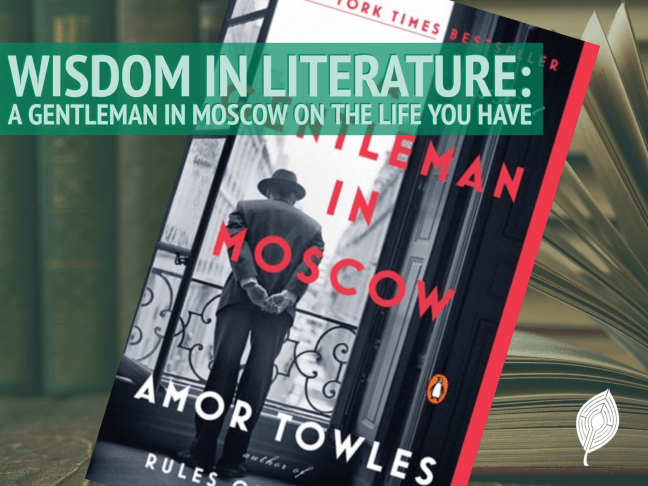
Today in this series on Wisdom IN Literature, I’m going to talk about one of my all-time favourites, Amor Towles’ A Gentleman in Moscow. It tells the story of a former Russian aristocrat whose life is spared by a Bolshevik tribunal because he had once written a poem that embodied certain socialist values. Instead of being executed, he is sentenced to life under house arrest in Moscow’s luxurious Metropol Hotel. Upon hearing about this premise, a friend of mine groaned, “This isn’t going to be a fancy man trying to stay fancy, is it?” And I instantly replied, “No, it’s a man of the world who creates a world for himself inside a single building.” This is the magic of A Gentleman in Moscow: its lead character’s ability to accept, adapt to, and bring meaning and joy into his vastly changed and limited circumstances. And it’s a great message for all of us, since, like it or not, life comes for us all, and life is all about change.
Count Rostov, the titular ‘Gentleman,’ learns this lesson early in life, when upon the premature death of his parents, he is told he must stay strong for his sister and understand that “if a man does not master his circumstances then he is bound to be mastered by them.” And later reflecting on his house arrest, he notes that “imagining what might happen if one’s circumstances were different was the only sure route to madness.” As the book progresses, we learn that not only has Rostov learned this equanimity in the face of life’s ups and downs, but has even come to appreciate them. Speaking to a young friend about the conveniences he once enjoyed, Rostov says, “At one time, I had them all. But in the end, it has been the inconveniences that have mattered to me most.” Along a similar line, the book’s narrator notes that:
…the Confederacy of the Humbled is a close-knit brotherhood whose members travel with no outward markings, but who know each other at a glance. For having fallen suddenly from grace, those in the Confederacy share a certain perspective. Knowing beauty, influence, fame, and privilege to be borrowed rather than bestowed, they are not easily impressed. They are not quick to envy or take offense. They certainly do not scour the papers in search of their own names. They remain committed to living among their peers, but they greet adulation with caution, ambition with sympathy, and condescension with an inward smile.
And again:
Alexander Rostov was neither scientist nor sage; but at the age of sixty-four he was wise enough to know that life does not proceed by leaps and bounds. It unfolds. At any given moment, it is the manifestation of a thousand transitions. Our faculties wax and wane, our experiences accumulate and our opinions evolve–if not glacially, then at least gradually. Such that the events of an average day are as likely to transform who we are as a pinch of pepper is to transform a stew.
So then, it is not our circumstances that define our life, but how we choose to respond to them. Looked at the right way, a single room “can, regardless of its dimensions, seem as vast as one cares to imagine.” As the narrator comments, “It was, without question, the smallest room that he had occupied in his life; yet somehow, within those four walls the world had come and gone.”
I can’t help but be reminded of the exceptionally wise philosopher and Holocaust survivor Victor Frankl, who wrote:
We who lived in concentration camps can remember the men who walked through the huts comforting others, giving away their last piece of bread. They may have been few in number, but they offer sufficient proof that everything can be taken from a man but one thing: the last of the human freedoms — to choose one’s attitude in any given set of circumstances, to choose one’s own way” (Man’s Search for Meaning).
Frankl is often quoted as saying that there is a space in between a stimulus and our reaction to it, and that “In that space is our power to choose our response. In our response lies our growth and our freedom.” All of this puts Count Rostov firmly within the world’s great Wisdom traditions. Equanimity is one of the main values in Buddhism, and is an undercurrent in positive psychology’s universal virtues such as humility, judgment, and perspective. And, it is profoundly Christian as well, as perhaps best seen in the Apostle Paul’s example in prison:
Not that I am referring to being in need; for I have learned to be content with whatever I have. I know what it is to have little, and I know what it is to have plenty. In any and all circumstances I have learned the secret of being well-fed and of going hungry, of having plenty and of being in need. I can do all things through him who strengthens me. (Philippians 4.11-13).
As widespread as it may be, this is nonetheless a hard teaching. None of us like to have unwelcome change thrust upon us. We don’t enjoy our plans going awry, losing our most cherished relationships, or facing circumstances beyond our control. But it is nonetheless a universal experience. Thus we would do well to learn to find meaning and beauty in the mess sooner than later. And I for one am so grateful to have Amor Towles’ wonderful creation Count Rostov as a wonderful exemplar.
 Matthew Root
One thought on “Wisdom IN Literature: A Gentleman in Moscow on Living the Life You Have”