
[This series explores the way some of my favourite novels engage with spiritual things. As much as I will try to avoid discussing major plot points, I will be using quotes from the novels and be discussing how they fit generally into the story. So please take this as a spoiler warning.]
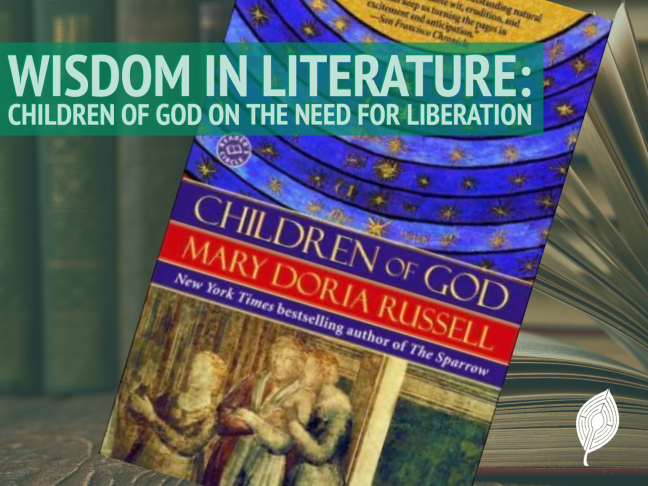
Mary Doria Russell’s The Sparrow is not a very well-known book, but it’s a very well-loved book by those who have read it (and stuck through its glacially-paced first 70 pages), myself most definitely included. But for me, its lesser-known sequel Children of God has stuck with me even more. Both books, sci-fi tales of a Jesuit mission to a nearby planet, are essentially exercises in theodicy, that is to say, explorations of the justice and goodness of God in light of suffering and evil. And the tack they take is similar to that of the Bible itself, especially the book of Job, which is to attempt a stance of non-judgement, acceptance, and awe in the face of the mysteries of life. As one character in Children of God says, “Wisdom begins when you discover the difference between ‘That doesn’t make sense’ and ‘I don’t understand.’” But as important as that theme is, it isn’t the one I’d like to highlight today. For Children of God plays with an idea that has haunted me and in some ways guided me ever since I read it almost a decade ago: That oppressors need to be freed from oppression as much as the oppressed.
This idea may sound strange and even insensitive at first glance. After all, who could say that the Egyptians needed to be freed instead of the enslaved Hebrews? But, the more I’ve thought about it, the truer I realize that it is. Oppression is essentially a rupture in the good and holy reciprocal relationship between two people or groups. And it’s unquestionably true that the first priority should be to raise up leaders who can free the oppressed party and allow them to find their own way in the world, apart from their relationship with the oppressor. But this only fixes half of the problem. Using the Exodus story as an example, the Hebrews needed Moses to free them and lead them to a new home and way of living. But the Egyptians were still oppressors. Their hearts were still hardened. They still expected, or even psychologically ‘needed’ an enslaved people, someone to ‘lord over’. If the Hebrews needed someone to show them how to be free, the Egyptians needed someone to someone to show them how to live without oppressing others. As Children of God states it, “What if Moses had been an Egyptian, raised among the Hebrews?” And, “It took forty years to burn the slavery out of the Israelites. Well, maybe the Jana’ata [an alien species in the book] need forty years to burn the mastery out of them!”
The point is that historically privileged or oppressive groups need strong internal leadership to show them that orienting themselves towards others in more equitable ways does not ‘lower’ them. The world does not need to be a zero-sum game, where other people gaining power and freedom reduces your own. But for those taught, implicitly or explicitly, that they need to be on the top of the heap in order to have value, oppression can be a hard habit to break, even if they want to. And this is so relevant to our present cultural situation. We’re faced on multiple fronts with historically marginalized or oppressed groups — whether defined by race, gender, sex, religion, or sexual orientation — gaining more influence and more powerful platforms but facing a simultaneous backlash by those in historically privileged positions. If we’re going to emerge from this unhealthy and dangerous dynamic, we need strong male leaders who can show other men, and especially boys, what healthy masculinity, which is neither fragile nor toxic, looks like; we need strong White leaders to show that it’s possible to be honest about historical racism and the ways it continues to impact racialized groups without falling into self-defeating shame and ‘self-flagellation’ and to demonstrate better ways of doing business and doing life; and we need strong wealthy folk to lead the way in breaking down our moment’s historically unprecedented gap between the haves and have-nots. We need strong leaders to help free us, as much from the ways of oppression as from being oppressed ourselves.
This is a powerful truth and I am so grateful for Mary Doria Russell for pointing it out to me so beautifully.
 Matthew Root