
If you’ve been following along the blog this week, you’ll know that during this Easter season I’m working more intentionally with practices that engage the realm of the imaginative and symbolic. I thought it would be interesting to carry that on in today’s reflection. If you’re not comfortable with such approaches, please check out a more customary reading of today’s Gospel from a few years ago.
There is nothing more important for Christian faith, theology, and life than the resurrection of Jesus. It’s an event that from our perspective literally changed everything. Everything. Because of this, it should come as no surprise that we can approach it from many different directions. We see this even in the New Testament: Paul, for example, talks about the resurrection as a metaphysical reality, which completes the reset of human nature that the Incarnation was all about (e.g., Romans 6.4-11). In the speeches in Acts, it’s spoken of as God’s vindication of Jesus’s life and ministry, and as a condemnation of the religious leadership that conspired to have him killed (e.g., Acts 3.13-16). But in today’s Gospel reading, we get a more personal approach to the resurrection. Here we see it framed not in terms of its theological consequences, but rather its impact on the lives of the disciples. We see it as an event that transformed them from a group of dispirited and frightened followers into people certain in their faith and vocation.
Let’s take a closer look, today paying particular attention to the symbols in the language John deploys in his narrative. Starting partway through John 20, the reading begins:
When it was evening on that day, the first day of the week, and the doors of the house where the disciples had met were locked for fear of the Jews, Jesus came and stood among them and said, “Peace be with you.” After he said this, he showed them his hands and his side. Then the disciples rejoiced when they saw the Lord. (John 20.19-20)
We begin at evening, a period of endings and beginnings, of transition. It’s also Sunday, “the first day of the week,” which also makes it the day after the Sabbath, and so the ‘eighth day’, which was in Jewish apocalypticism of the day, the day of God’s hyper-perfect re-creation of the world. So the setting here is symbolic of transition and big, God-driven changes. But, “the doors of the house … were locked for fear.” The defenses, both psychological and physical, are up. The psyche is closed off and guarded. This reads so much like times of depression, anxiety, or learned helplessness. Nothing can get in and we’re at the point where we don’t want it to. We might be miserable, but the misery we know feels safer than whatever might be waiting for us on the outside. And so our scene is set: We’re in a place of needed transition, but are closed off from the world, seeing change as a threat rather than an opportunity.
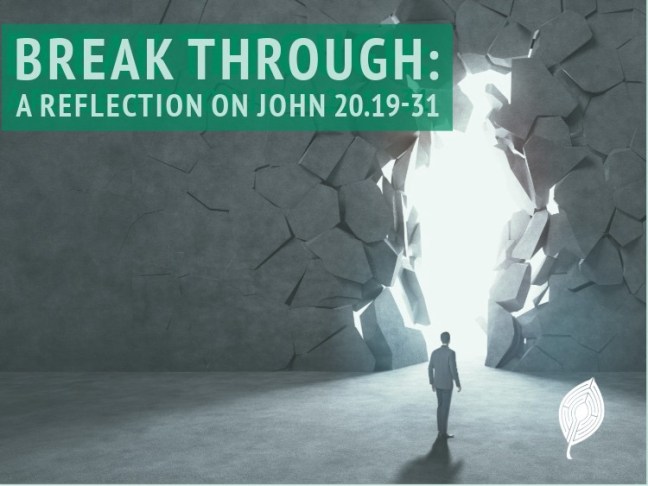
But then, somehow Jesus breaks through our defenses. Certainly as Christians, we can take this on a literal level: In times when we’re particularly in our heads and cut off, Jesus can break through and release us to a new and open of way of life. That works well, and as Christians this will be our first and primary reading of it. But thinking in purely symbolic terms, this breaking in of Jesus could also represent the breaking in of what Jung called the Self, what we might clarify as our true and best self. This association is not just psycho-babble. In fact, we can root it firmly in Christian theology: Whether it’s Jesus as the logos, the grammar of creation that is imprinted in all of us, or as the exact image and likeness of God in which we were created and into which we are called to grow, or the idea of Christians as literally ‘Christ-lings’, our tradition is full of language that insists that our truest, deepest self looks and sounds like Christ. With this in mind, we have the true self—that part of us that is connected to and reflects God back to us—sneaking in behind our defenses. And it can do this because it’s truer and deeper, more authentically ‘us’ than any of those walls we build up.
And as jarring, and maybe even as unwelcome, as this experience is (after all, we spend a lot of time and energy building and maintaining those walls!), when this true self or ‘Christ within’ shows up, it doesn’t do this to harm or destroy us, but rather it offers us peace. In stories like this, it’s hard to know how much weight to put on a word like “Peace.” After all, it was just the standard greeting of the time. Jesus could just be saying hello, or he could be saying so much more. A symbolic reading like the one we’re doing today frees us to let go of those concerns and lean into the more meaningful possibilities. For in the biblical vision, peace is not just the absence of violence but the presence of whole, healed, and healthy, reciprocal relationships. So, the true self shows up and offers us a path of wholeness, connection, and good-faith.
Then it does something interesting. It shows us its wounds. I love this detail in this symbolic exploration of the text: Our true self is not some perfect golden child that has not known pain or disappointment: it bears our wounds and scars. It knows how badly we’ve been hurt and why our guard is up. That’s why we know we can trust it.
The story continues:
Jesus said to them again, “Peace be with you. As the Father has sent me, so I send you.” When he had said this, he breathed on them and said to them, “Receive the Holy Spirit. If you forgive the sins of any, they are forgiven them; if you retain the sins of any, they are retained.”
And when this self shows up, it does so bearing not only the promise of that wonderful divine peace, but also with a vocation. This is what Joseph Campbell could call the soul’s summons, or the call to adventure. We’re being called out from behind our walls and into the world, not to face it from a position of fear, but with a calling. The specifics of that calling will be unique to our personality, gifts, and circumstances, but it will always be some manifestation of the gracious, humble, life-giving way of Jesus. As God sent him, so he sends us, so our truest self calls us out to love and serve the world. But we aren’t left alone to accomplish this: we are given a vocation, but also the dynamism and authority to live it out.
But the story doesn’t end there, and I think the second half is just as interesting on a symbolic level:
But Thomas (who was called the Twin), one of the twelve, was not with them when Jesus came. So the other disciples told him, “We have seen the Lord.” But he said to them, “Unless I see the mark of the nails in his hands, and put my finger in the mark of the nails and my hand in his side, I will not believe.” A week later his disciples were again in the house, and Thomas was with them. Although the doors were shut, Jesus came and stood among them and said, “Peace be with you.” Then he said to Thomas, “Put your finger here and see my hands. Reach out your hand and put it in my side. Do not doubt but believe.” Thomas answered him, “My Lord and my God!” Jesus said to him, “Have you believed because you have seen me? Blessed are those who have not seen and yet have come to believe.” (20.24-29)
Even here, when we experience this incredible breakthrough that calls us up and out, part of us is not present to that moment, and is not convinced by it. Symbolically, it’s a great detail that John notes that Thomas was known as ‘the Twin’: that other self that cannot accept the calling is a doppelganger, a self but a false self. I’m reminded of Jung’s “Personality 1” and “Personality 2” here. Living in and coping with the world and our experiences, it’s natural for us to compartmentalize. We can express certain parts of ourselves safely only in some places, if at all, so we learn to hide them, or share them only cautiously. These lesser, smaller versions of ourselves can put on public personas and roles more easily. They’re useful as coping mechanisms, but are disastrous for our soul’s integration. And here we have one of these pieces that refuses to accept the call to adventure, doesn’t trust the one who is calling us. This skepticism is born out of its trauma; it’s not until it can really probe, even violate, the one who is calling that it can trust that they truly are who they say they are and really have the wounds to show for it.
This is helpful, I think, because it shows that those more skeptical parts of us that aren’t ready to unlock the doors and let down the guard and go out into the world aren’t our enemies. They’re just trying to protect us. But we can also bring them along; the summons is always there for them. And when they are ready an answer it, they can be among the boldest and bravest of all.
At the end of the day, this symbolic reading isn’t all that different from a more customary one. But I still think it’s valuable and even beautiful. The true self, the Christ within, is always summoning us out of our darkness and despair, calling us into the world so we can grow into our full self, which is nothing other than the full stature of Christ.
During this Easter season, may we all be attentive to this voice, let go of the baggage that hinders us, and begin the adventure.
Amen.
 Matthew Root