
One of the most common debates among committed Christians over the centuries has been the relative importance of personal piety versus acts of compassion. It’s played out on a lot of fronts: The action versus contemplation debate in monastic circles, the faith versus works debate of the Reformation era, and in the present attacks today by so-called ‘conservative’ Christians against what they consider to be ‘woke’ Christianity. But as we’ve seen recently in our main series looking at the ways God’s people’s understanding of God evolved over time, these debates are nothing new. A similar spirit is at play in the Old Testament debates between the Deuteronomistic History and the Prophetic Critique: They agreed that adherence to God’s Law was of vital important for their people, but disagreed about what the focus of that adherence should be: worshiping God in the right way for the Deuteronomists, justice for the poor and oppressed for the Prophets. All of these debates basically boil down to the same question: Is faithfulness primarily a matter between me and God, or is it also about me and my neighbour?
As we saw last week, the Scriptures’ consistent answer to the question is that it’s a false dichotomy. Both parts are equally important. We must “Love the LORD our God with all our heart and will all our soul and with all our mind,” and “Love our neighour as ourself.” For “on these two commandments hang all the Law and the Prophets” (Matthew 22.38-40; cf. Deuteronomy 10.12 & Leviticus 19.18; Micah 6.8; Ecclesiastes 12.13). All this brings us to the Psalm appointed for today, which perfectly captures this spirit:
Hallelujah!
Happy are they who fear the LORD and have great delight in his commandments!
Their descendants will be mighty in the land; the generation of the upright will be blessed.
Wealth and riches will be in their house, and their righteousness will last for ever.
Light shines in the darkness for the upright; the righteous are merciful and full of compassion.
It is good for them to be generous in lending and to manage their affairs with justice.
For they will never be shaken; the righteous will be kept in everlasting remembrance.
They will not be afraid of any evil rumours; their heart is right;
they put their trust in the LORD.
Their heart is established and will not shrink, until they see their desire upon their enemies.
They have given freely to the poor, and their righteousness stands fast for ever;
they will hold up their head with honour.
The wicked will see it and be angry; they will gnash their teeth and pine away;
the desires of the wicked will perish. (Psalm 112)
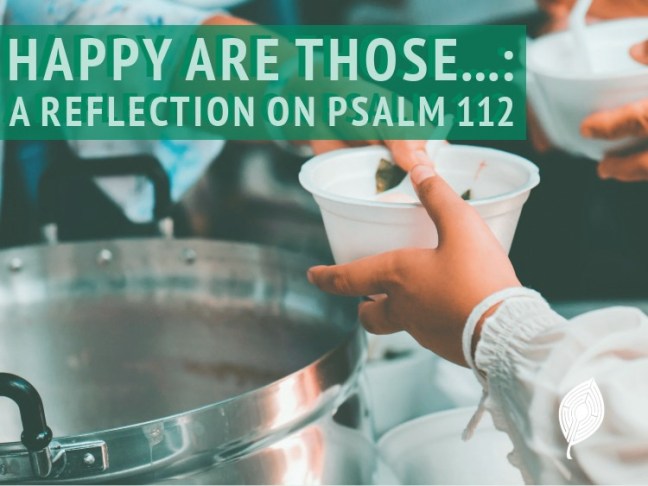
Here we have probably the clearest articulation in the Old Testament of just how deeply personal piety and social justice are intertwined in the genuine life of faith. It starts off in the typical Deuteronomist language of the covenant blessings awaiting the faithful, but then defines that faithfulness not primarily in terms of proper worship, or even ritual purity, but entirely in terms of love of neighbour:
- compassion
- generosity in lending
- justice
- not giving into rumour or scandal
- big-heartedness
- giving freely to the poor
It also reminds us that this type of behaviour is always going to anger the wicked. (We might even say that we can define wickedness as precisely this kind of derision and hatred of those who do good for others.)
The point is that the dichotomies we too often see between personal piety and service are entirely and wholly false. Not only are both important in the life of faith, but they should exist in what we’ve previously called a ‘positive-positive polarity’ or dialectical relationship: The more we focus on our relationship with God, if we are legitimately engaging that relationship, the more we will be moved to serve others; and the more we focus on service for others, if we are legitimately doing so out of a desire for justice and not to puff up our own egos, the more this service will draw us to God. It’s not a question of contemplation or action, of faith or works, of righteousness or justice. It’s a question of more contemplation and more action, of more faith and more works, of more righteousness and more justice.
In this way we will truly be, in the words of today’s Gospel reading, salt and light for the world, like a city shining on a hill for all to see.
Amen.
 Matthew Root