
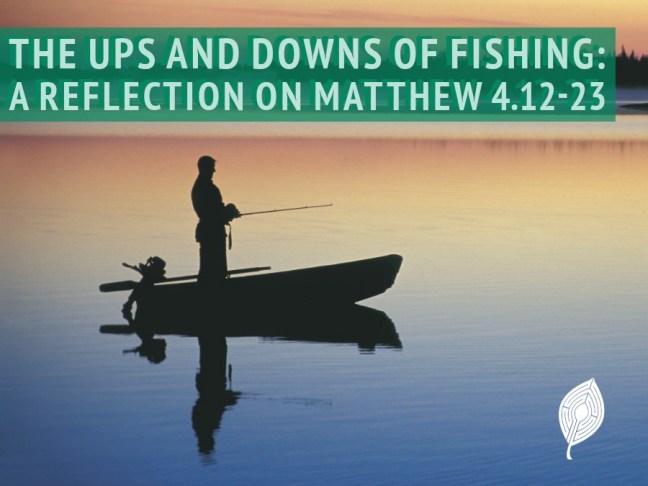
Last week, we saw how the departure of some of John the Baptist’s disciples to follow Jesus was not a rejection of John’s ministry, but its fulfillment, and how, as followers of Jesus we too much point to him through our thoughts, words, and actions. Today’s readings bring our attention to the second half of that message.
Let’s start by looking at the Gospel:
Now when Jesus heard that John had been arrested, he withdrew to Galilee. He left Nazareth and made his home in Capernaum by the sea, in the territory of Zebulun and Naphtali, so that what had been spoken through the prophet Isaiah might be fulfilled: “Land of Zebulun, land of Naphtali, on the road by the sea, across the Jordan, Galilee of the Gentiles – the people who sat in darkness have seen a great light, and for those who sat in the region and shadow of death light has dawned.” From that time Jesus began to proclaim, “Repent, for the kingdom of heaven has come near.” As he walked by the Sea of Galilee, he saw two brothers, Simon, who is called Peter, and Andrew his brother, casting a net into the sea – for they were fishermen. And he said to them, “Follow me, and I will make you fish for people.” Immediately they left their nets and followed him. As he went from there, he saw two other brothers, James son of Zebedee and his brother John, in the boat with their father Zebedee, mending their nets, and he called them. Immediately they left the boat and their father, and followed him. Jesus went throughout Galilee, teaching in their synagogues and proclaiming the good news of the kingdom and curing every disease and every sickness among the people. (Matthew 4.12-23)
It begins with Jesus removing himself from the area around Jerusalem following John’s arrest and settling in the north. But if this is a retreat, it’s a tactical one, as it also marks the start of his own ministry. In very Epiphany-coded language, the Gospel cites Isaiah’s famous words about a great light shining on the benighted people of that part of the country. Jesus calls the people there to repentance, and begins to gather his own disciples, saying to a group of fishermen: “Follow me, and I will make you fish for people.” And as those who too receive and obey the call to follow Jesus, Christians throughout the century have taken this call to ‘fish for people’ as our own. We see this in the New Testament in the missionary journeys of Paul, and the first apostles’ evangelistic zeal quickly spread the Gospel throughout the then-known world and beyond, from the Maghreb to India, and from Ethiopia to Britain. And, this call also inspired, in all the good and bad ways, later missionary activity in the Americas, East Asia, and Sub-Saharan Africa.
With all the talk of light shining in darkness, and reeling people in, this can easily come across as triumphalist. And all too often throughout history, it has been so. Thankfully, today’s Epistle reading reminds us of some of the pitfalls of such missionary zeal:
Now I appeal to you, brothers and sisters, by the name of our Lord Jesus Christ, that all of you be in agreement and that there be no divisions among you, but that you be united in the same mind and the same purpose. For it has been reported to me by Chloe’s people that there are quarrels among you, my brothers and sisters. What I mean is that each of you says, “I belong to Paul,” or “I belong to Apollos,” or “I belong to Cephas,” or “I belong to Christ.” Has Christ been divided? Was Paul crucified for you? Or were you baptized in the name of Paul? I thank God that I baptized none of you except Crispus and Gaius, so that no one can say that you were baptized in my name. (I did baptize also the household of Stephanas; beyond that, I do not know whether I baptized anyone else.) For Christ did not send me to baptize but to proclaim the gospel, and not with eloquent wisdom, so that the cross of Christ might not be emptied of its power. For the message about the cross is foolishness to those who are perishing, but to us who are being saved it is the power of God. (1 Corinthians 1.10-18)
There are a few dangers Paul talks about here:
-
- Rivalry: From the beginning, Christianity has had a lot of diversity. There’s always been a tendency to let differences in ways of talking about the faith, or even just a spirit of tribalism, to get in the way of seeing the bigger picture. It’s not about my team or yours, but only about Jesus. Connected to this,
- Numbers-based definition of success: Paul puts it plainly here; he was net sent to baptize, to rack up numbers of converts, but simply to preach the Good News of Christ and the coming of God’s kingdom. If we mess this up we will necessarily,
- Empty the cross of its power: The cross is the defining theme of the Christian message. And there is no room for triumphalism in it. Because it tells us that victory in God’s terms looks like defeat in human terms. This is never a popular or easy message, so it’s also tempting to,
- Play to a message ‘that sells’: We can’t get this twisted. The Gospel is utter foolishness by the standards of the world we live in. It runs counter to ‘the way the world works’, to ‘common sense’. And so it’s always tempting to blunt its message to conform. (The clearest example I’ve seen of this, and I’ve seen it play out in many different denominations and cultural contexts, is how hard it is for preachers to teach honestly about Jesus’ message against the love of money. But this is just one example)
It all comes down once again to Martin Luther’s insightful division between the ‘theology of glory’ and the ‘theology of the cross.’ The two are incompatible. A message about God’s blessing and prosperity and national glory and strength upon strength will always be popular, but it is not the Gospel of Jesus Christ — in fact it’s the opposite of it. The Gospel dares to tell us that it is the meek, the grieving, and the poor who are blessed, that the only strength worthy of the name is revealed in weakness, that wealth is found in giving, that security is found in welcoming the outcast, that justice looks like compassion and forgiveness, and that following the way of truth entails carrying the cross — not a symbol of devotion, but the instrument of our own persecution and death.
Unless this is our message, we are not shining light into the darkness, but just yelling more darkness into an already dark world.
Once again this week, I’ll end with this prayer: And so, in these weeks after Epiphany, may we, with John and all the prophets before him, and all the apostles and saints after him, “let our light shine before others, so that they may see our good works and give glory to our Father in heaven,” in the name of Jesus.
Let’s just make sure that what we’re spreading is actually light.
Amen.
 Matthew Root