
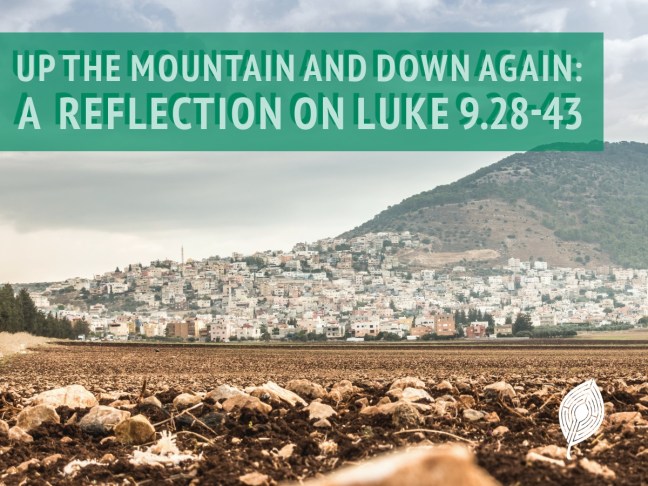
Longtime readers will know that I love the story of the Transfiguration. I come by it honestly, since I studied the theology of light for my Master’s thesis back in the day, a tradition in which this story which seems strange to many becomes a blueprint for Christian spirituality. But the thing about peak religious experiences like the one Jesus and his apostles experience here on the mountaintop in this reading is that they can’t last forever, and they’re not meant to. And so I love Luke’s version of the story, which relates the messy story of what comes next. And this too is in its own way a blueprint for Christian spirituality.
First let’s remind ourselves of the story. Jesus brings three trusted disciples with him up to a mountaintop where he can pray away from the crowds. But while he’s praying, the disciples see him completely changed: he starts to shine with a blindingly bright light, and those two great heroes of Jewish faith, Moses and Elijah, the very personification of the Law and the Prophets, and Israel’s past and anticipated future, appear at his side. The disciples are in their glory and try to make preparations for Moses and Elijah to spend the night with them, but they are interrupted by a heavenly voice urging them to listen to Jesus and suddenly, the experience ends and they are left alone with Jesus, who is also returned to his normal appearance.
Mountaintops are places rich in spiritual significance, across the world, but particularly in the Ancient Near East, where they were believed to be the dwelling places of God. Moses first encountered God on a mountainside in the form of the burning bush, and later received the tablets of the Law on Mount Sinai — an experience that left him too shining brighter than the sun. And after his disastrous ‘win’ against the priests of Ba’al, Elijah fled to the mountains and also met God there — not in the fire storm or earth quake, but in the sound of silence. And so it’s fitting that Jesus would meet these two figures and reveal his true glory here too on a mountaintop.
But you can’t stay on the mountaintop forever. Such peak religious experiences cannot last and they are never given for show but to prepare us for what comes next. And, as a general rule, what comes next is never fun. Moses left the Burning Bush with an impossible mission to free a people enslaved by the world’s greatest superpower. He left Sinai to discover that that people was now celebrating their freedom by worshiping a god other than the one who had freed them. Elijah left his mountaintop with a mission far more quiet and mundane than what he’d been used to. And here too Jesus descends from the mountain with an unwelcome mission. For the text tells us that what he’d been talking about with Moses and Elijah was his upcoming death in Jerusalem. But even before he can deal with that upon coming down from the mountain, he has to deal with a messy situation in which the disciples he’d left behind had become embroiled:
On the next day, when they had come down from the mountain, a great crowd met him. Just then a man from the crowd shouted, ‘Teacher, I beg you to look at my son; he is my only child. Suddenly a spirit seizes him, and all at once he shrieks. It throws him into convulsions until he foams at the mouth; it mauls him and will scarcely leave him. I begged your disciples to cast it out, but they could not.’ (Luke 9.37-40)
I always feel for the disciples here. (It reminds me of one of my first jobs, when the store got really busy and I had not yet been trained on the register and my supervisor had had to take a call from the back room. I don’t think I’ve ever been so glad to see someone as I was when she returned!) At any rate, they’d tried and failed to heal the boy and everyone was at their wit’s end. Even Jesus can’t keep the exasperation from showing in his response:
Jesus answered, ‘You faithless and perverse generation, how much longer must I be with you and bear with you? Bring your son here.’ While he was coming, the demon dashed him to the ground in convulsions. But Jesus rebuked the unclean spirit, healed the boy, and gave him back to his father. And all were astounded at the greatness of God. (41-43a)
As frustrating as must have been for Jesus, it was just distraction for Jesus. Here he was contemplating his betrayal and death and he has to deal with this mess! It’s clearly still on his mind since, this text leads directly into Jesus telling his disciples once again that he would be betrayed.
All this just sounds so very realistic to me, on two levels. First, our peak experiences aren’t just given out for the fun of them, but they prepare us for what’s ahead — whether, like Jesus or Elijah we’re given a heads up about it, or like Moses, we are not. But even beyond that, we still have to deal with all the urgent little things that pop up and which so easily distract us from the path before us, or keep us from making much progress down it. And second, for much of Christian history, the season of Lent has been seen to be something akin to our own long journey to Jerusalem and the events of Holy Week. This road too is littered with frustrating distractions and delays that can easily prevent us from experiencing Lent as fully as we’d like, or maybe even should.
And so, today, may we remember our destination — whether that’s the challenging vocation for which we’ve been prepared, or whether that’s simply keeping a good Lent — and set our own faces like flint, and be ready for whatever may come our way.
 Matthew Root
One thought on “Up the Mountain and Down Again: A Reflection on Luke 9.28-43”