
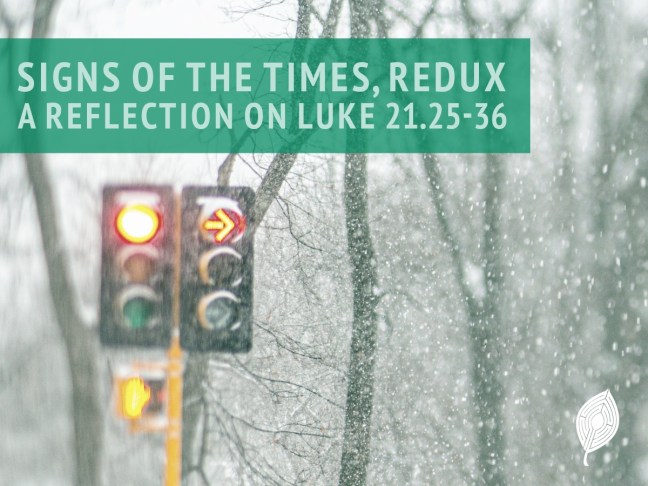
Two weeks ago, we saw how Jesus tried to reign in his disciples’ apocalyptic ideas, warning them that wars, famines, and disasters will always be with us and so not to be taken in by them and the false prophets they always inspire. But today’s Gospel reading takes a rather different tack with similar ideas and images. As I’m currently on vacation, I thought I’d share mostly what I wrote about this passage three years ago. But I’ll return at the end for some final thoughts for 2024.
—
There will be signs in the sun, the moon, and the stars, and on the earth distress among nations confused by the roaring of the sea and the waves. People will faint from fear and foreboding of what is coming upon the world, for the powers of the heavens will be shaken. Then they will see the Son of Man coming in a cloud’ with power and great glory.
Well, Jesus, welcome to Advent to you too.
The annual turn to Apocalyptic this time of year always comes as a bit of a shock to the system. “Oh it’s Advent!” we’d like to think. “Time to prepare for Christmas and the little bundle of joy that is the Baby Jesus” (capital ‘B’ on ‘Baby’ of course). But the Church has other plans for us. At a time of year when we might want a warm cup of hot cocoa, the Church splashes us with cold water. For Christmas is not an ‘all is calm, all is bright’ sort of holiday, and we need to be ready for it. And so the Church offers us a boot camp of challenging themes, like hope, peace, joy, and love.
Apocalyptic literature speaks the language of hope to hopeless people. It promises needed change in heaven-rending and earth-shattering terms. It’s not fun to read these passages; they are filled with images that are both terrifying and yet also somehow seem ripped from the headlines. They feel strange and remote but disturbingly of the moment. And so Apocalyptic is disorienting. It leaves us unsettled and wondering what on earth, and when on earth, these images are all about. Are these texts about first-century geopolitics? Are they about some future time, prophecies of the end of the world? Or are they speaking to us today?
The best answer to these questions is ‘yes’. It’s pretty clear that Apocalyptic addresses specific times and places: the Apocalyptic portions of Daniel address the Maccabean revolt, for example; texts in the Gospels like today’s (from Luke 21) are about the Roman occupation and the destruction of Jerusalem; and Revelation addresses a particularly intense time of persecution against Christians in Asia Minor. And yet, there has never been a time when they have not felt eerily contemporary, and in this way, they are evergreen. They always point us beyond the past, into today’s problems, and into the anxious future.
The point of such texts is not to threaten or terrify, and certainly not to predict the future (Remember, Jesus was clear on this point: “But about that day and hour no one knows, neither the angels of heaven, nor the Son, but only the Father” (Matthew 24.36)). The point is to remind us that God is at work in our world, no matter how grim or dire things look.
The message for us is to keep watch, to recognize the signs of the times and see in them how God is at work, how God is present with us:
Heaven and earth will pass away, but my words will not pass away. Be on guard so that your hearts are not weighed down with distraction, drunkenness, and anxiety, and that day catch you unexpectedly…
It’s hard not to read “distraction, drunkenness, and anxiety” as perfect descriptions of so much of life today. It’s all the more reason to to push our attention through the floods and fires and tempests, and “wars and rumours of war” that fill up the news and see where God is at work. And so, this is a call to see the change that is needed in our world, and to stop, look, and listen to discern the signs of our times.
—
As I return to these words in 2024, they feel even more vital than they did three years ago. These are, like all times, apocalyptic times. Remember, Apocalyptic is not about the end of time, but about a revelation of what is. Despite its fanciful images, the goal of Apocalyptic is to pull the mask off of the world as we know it. In this way, all times are Apocalyptic: Just as “a tree will be known by its fruit” so too are our societies revealed by our collective anxieties, crises, and actions, what lies beneath the surface of ‘all is well’ and ‘nothing to see here’. All too often, what such everyday apocalyptic times reveal is not flattering. Such is the human condition. Our dirty secret is that ‘the way the world works’ does not, in fact, work well.
This is why, this Fall, I was drawn to write on the Sermon on the Mount, that wonderful collection of teachings of Jesus that is apocalyptic in its own way, revealing to us a new and different way of being in the world, and challenging us to imagine a world grounded in grace, compassion, mercy, and love. These ways, this alternative Kingdom of God, are always present, always at work around us, if we but have eyes to see and ears to hear.
And this is, I think, the challenge of this season. To read the signs of the times and understand what it is they are revealing about us, and yet not to lose heart, and to read just as clearly the ways God is at work in this hurting world.
Stay alert, dear friends. The kingdoms of this world always disappoint, with their wars and rampant injustice. But, the message of Advent is that the Kingdom of Heaven is at hand. It is among us, and within us. And this is Good News indeed.
 Matthew Root