
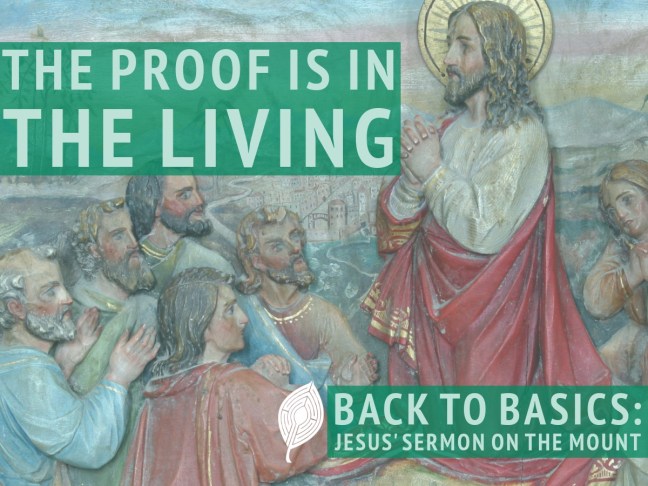
Today marks the end of this series on the Sermon on the Mount. It seems fitting since tomorrow also marks the end of the Western Christian calendar. And what better time to conclude our reflections on Jesus’ teachings revealing the ways of the Kingdom of God than these final days before Advent, which is all about our longing for the coming of God’s Kingdom here on earth. As we might expect from such apocalyptic themes, Jesus’ sermon ends with a warning to all those who hear his words. And I can think of no better way to wrap up both this series and the liturgical year.
Jesus begins:
Not everyone who says to me, “Lord, Lord”, will enter the kingdom of heaven, but only one who does the will of my Father in heaven. On that day many will say to me, “Lord, Lord, did we not prophesy in your name, and cast out demons in your name, and do many deeds of power in your name?” Then I will declare to them, “I never knew you; go away from me, you evildoers.” (Matthew 721-23)
These are strong words from our Lord, but they say something we need to hear. The life of faith to which we are called is not about great manifestations of the Spirit, but about how our life impacts the world around us. As Paul put it:
If I speak in the tongues of mortals and of angels, but do not have love, I am a noisy gong or a clanging cymbal. And if I have prophetic powers, and understand all mysteries and all knowledge, and if I have all faith, so as to remove mountains, but do not have love, I am nothing. If I give away all my possessions, and if I hand over my body so that I may boast, but do not have love, I gain nothing. (1 Corinthians 13.1-3)
Miracles, signs, and wonders are all well and good, but they are not the point. We are not called to bring down lightning from heaven, but to love our neighbour as ourself. This is entirely in keeping with the spirit of the Sermon on the Mount, and Jesus’ teachings as a whole. True faith is not expressed in great prayers, public displays of piety, or even miraculous deeds, but in how we carry ourselves in the world when the cameras are off and no one is looking: how we treat our family after a long day at work, how we treat the customer service agent on the phone, how we treat the cashier at the grocer, how we support the poor, downtrodden, and marginalized of our society. To return to the idea of ‘God’s economy’, if we are not inspired to share the love, mercy, and grace of God that we have experienced with others — even those we’d least want to if left to our own devices — have we even really experienced that love, mercy, and grace? Can we even say that we know the one we call our Lord? And so, as Jesus put it, he will truly say that he never knew us.
He continues:
Everyone then who hears these words of mine and acts on them will be like a wise man who built his house on rock. The rain fell, the floods came, and the winds blew and beat on that house, but it did not fall, because it had been founded on rock. And everyone who hears these words of mine and does not act on them will be like a foolish man who built his house on sand. The rain fell, and the floods came, and the winds blew and beat against that house, and it fell—and great was its fall!’ (7.24-27)
As shocking as it may be, there are Christians out there today who claim that all of Jesus’ teachings are meant for the next world and so we aren’t expected to follow them in this world. These words here should be enough to reject any such ideas wholesale. To be wise is to hear Jesus’ words and act on them, live them out. These are the only firm foundation for the true life of faith. Even a beautiful Church can be washed away to nothing if it’s built on any foundation other than the way of grace, mercy, and love.
Again, we come to the dispiriting truth that none of this sounds like public-facing Christianity in our world today. And again, I maintain this is because the ways of religion — purity culture, legalism, concern with self-protective boundaries over welcoming others, and public piety — come naturally and easily to us as humans, far more easily than the ways of faith to which Jesus calls us. But today, tomorrow, and always, if we are to call ourselves Christians, we must always remember that our calling is nothing less than to be christs to the world, offering his love and showing his ways to a broken world. And as we’ve seen over the past few weeks, these ways:
- insist that it is the humble, the grieving, those who yearn for justice and work tirelessly for peace and wholeness, and who persist in doing all this in the face of opposition, who are truly blessed
- enhance the good that is present in the world and society and bring light where there is darkness
- reveal that true faith is not about fulfilling the letter of the law, but the heart and motivation behind how we act in the world, and always being in choice over our actions
- are public in scope — including not only our relationship with God, but also our relationships with ourselves, with our communities, and the whole world — but private in orientation — they are not for show or to be seen
- hold the treasures of this world with an open hand, focusing instead on God’s kingdom values of compassion, love, and grace — because our hearts and actions will always follow whatever it is we truly treasure
- trust in God’s provision, remembering that anxiety does nothing to extend our lives or avoid the negative outcomes we so fear
- refuse to condemn and cast judgement upon others when we have received forgiveness and mercy from God
- don’t waste what is truly good, true, and beautiful on those who are not able to appreciate it
- are persistent in seeking what is good, trusting that God’s generosity and goodness
- treat others as we want to be treated
- focus on making positive impacts on the world more than our ideas of ‘right’ and wrong’
These are big, beautiful, expansive ideas that rest at the very heart of the Gospel message. And yet, human nature being what it is, and the pressures of human societies being what they are, they are also very hard. And so this expansive way of Jesus is also a very narrow road, which few are able to find.
At the end of these three magnificent and challenging chapters outlining Jesus’ teaching, Matthew 7 ends with this simple summary of the crowd’s reaction: “Now when Jesus had finished saying these things, the crowds were astounded at his teaching, for he taught them as one having authority, and not as their scribes (7.28-29). And that’s often our reaction too. These words, no matter how familiar or foreign they may be, always sound impressive and shocking. They aren’t ‘the way the world works’, even the world of the Church, and they demand that we be brave and creative enough to imagine a different world, a different way. We know they are right even as we struggle to imagine how to actually live them out.
But this is our calling as Christians. And thankfully, we have been given the gift of the Holy Spirit to help us do it.
And so, as we look ahead to this season of new beginnings — the start of our liturgical year on Sunday, the fulfillment of our cultural calendar on Christmas, and New Year’s itself — may we remember all these words of our Lord, treasure them in our hearts, and commit ourselves to living them out as we start anew.
 Matthew Root
2 thoughts on “Faith Is In the Living”