
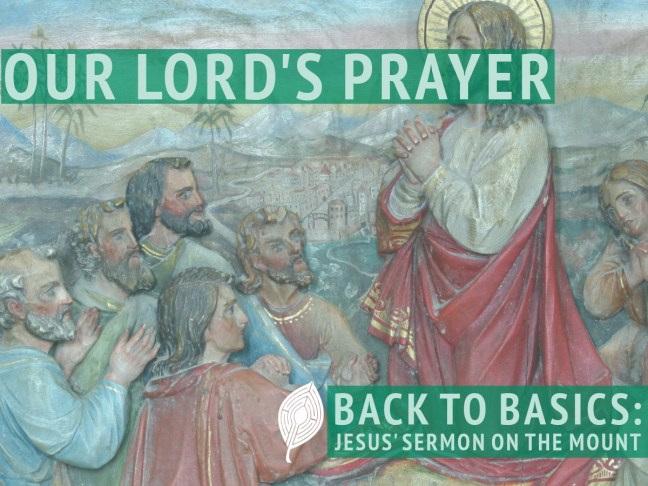
Last time, we saw how Jesus warned his followers against public displays of piety. But, within this section of the Sermon on the Mount he not only teaches us how to pray (simply and in private), but also offers an example of what to pray. This has come down to us in the words known by rote to pretty much every Christian in every tradition, called ‘the Lord’s Prayer’. Each line of this prayer could easily warrant a post — or book — of its own, but for today’s purposes, I’ll try to briefly summarize each line, how it contributes to the ethos of the prayer, and to the teaching of the Sermon on the Mount as a whole.
Our Father in heaven, hallowed be your name: The prayer begins, as all prayer should, with an acknowledgment of God’s holiness and transcendence. Whether we are in times of happiness or sadness, success or failure, God remains God. While it’s lost a bit in translation, ‘hallowed be your name’ is not a declaration but a prayer — ‘may your name be rightly acknowledged as holy’ — recognizing that we all too often do not live in a way befitting our God’s holiness. And yet even in this setting God apart as transcendent, there is still the familial intimacy of calling God ‘Father’, something Jesus didn’t invent but certainly popularized. God is God, ‘wholly other’, yet God is ours, and is our father.
Your kingdom come, your will be done, on earth as in heaven: This is in a sense the whole spirit of Jesus’ teaching and especially the Sermon on the Mount. God is a king, but God’s kingdom is not like the kingdoms of this world. It does not operate on the same cynical realpolitik and oppressive power structures as human empires. This petition expresses our longing for God’s ways to come on earth, to bring true peace and justice — which again, is marked by healthy, healed, and whole reciprocal, ‘good faith’ relationships — to earth, since our own efforts will always be partial successes at best. It’s important to remember that this petition is first and foremost for those this world oppresses and marginalizes. To put it in Martin Luther’s terms, this is not a theology of glory — not a call for a triumphant Christianity over its ‘enemies’ (for Christ tells us not to have enemies!), but a call for justice ‘from under the rubble’.
Give us today our daily bread: This petition reminds us to focus on what is directly in front of us. Life is filled with so much anxiety for the future. But what we really need is what is sufficient for today. All life is lived one day at a time, hour by hour, minute by minute. This petition is literal, asking for our immediate physical needs to be met, but also spiritual — for as Jesus reminded Satan in the wilderness, “One does not live by bread alone, but by every word that comes from the mouth of God” (Matthew 4.4); and as Jesus promised that those who “hunger and thirst after righteousness [or justice] .. will be filled” (Matthew 5.6), and also said “I am the bread of life” (John 6.35). Through this last reference, it can also take on a Eucharistic sensibility. But no matter the area of life we’re thinking of, it remains that this is a confident request for God to give us what we need — whatever that may be — for the day before us.
Forgive us our debts, as we also have forgiven our debtors: Debt and debt-forgiveness is one of the primary metaphors Jesus uses for sin and salvation — we even use the term ‘forgiveness’ now, properly from this economic domain, to describe the wiping away of our sins. Note here the contingency: we ask for forgiveness from God as we have forgiven others. Jesus makes this idea, which I’ve elsewhere called ‘God’s economy’, explicit a couple verses later: “For if you forgive others their trespasses, your heavenly Father will forgive you too; but if you do not forgive others, neither will your Father forgive your trespasses” (6.14-15). We receive God’s mercy, love, compassion, grace, and forgiveness; we offer God’s mercy, love, compassion, grace, and forgiveness to others. We give grace; we receive grace. It’s all the same thing. (This is part of why Jesus is so hard on the accrual of wealth; in God’s economy, blessings and gifts are meant to be shared.)
And do not lead us to the time of trial, but deliver us from the evil one: Finally, we pray that we will be spared from temptations, trials, and tribulations — all the wiles, plans, and schemes of those who would seek to harm us, physically or spiritually. As long as we live in ‘this world’, such trials are inevitable — and the more we seek to live out and advocate for God’s ways of justice and peace, the more we’ll be in the cross-hairs of this world and its power brokers. (And such people are just as likely to be found within the community of faith as outside of it.) And so we pray for divine protection, for wisdom, and for such difficulties to be put off as much as possible.
If you’ve been paying attention to this series on the Sermon on the Mount, you’ll no doubt see a lot of harmony between the teachings we’ve looked at so far and what Jesus says in this prayer. This prayer, and the spiritual posture before both God and the world it seeks to create, could be said to be a checklist of what it looks like to be ‘poor in spirit’. It’s prayer that has no illusions about the world, its problems and struggles, and the opposition the faithful will face in it. And yet it’s also a prayer that upholds God’s transcendence over it all, and the goodness and grace God showers down upon us in the midst of it.
And so, let us pray.
 Matthew Root
7 thoughts on “Our Lord’s Prayer”