
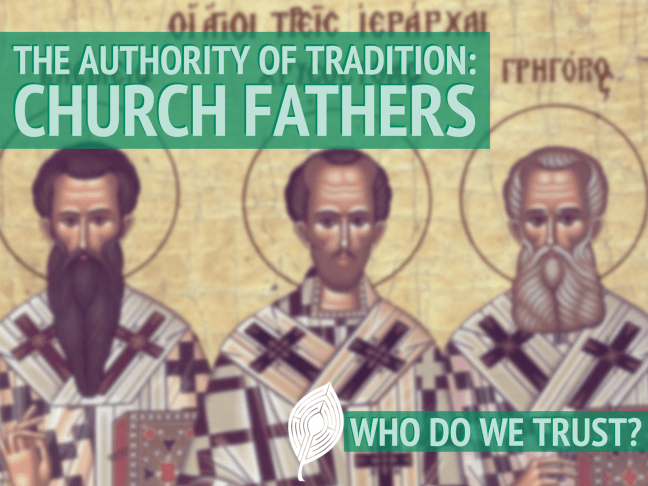
Tuesday’s post in this series on the complex nature of authority in Christianity looked at the roles creeds, confessions, and canons play in different traditions. These are statements of belief or decisions about common practice that have been formally adopted by churches to be normative or regulative within their communities. But part of what makes these documents fascinating is that we don’t just have them as records, but also the whole theological discussions that lay behind them. This puts us in a good place when interpreting the Creeds, because, for example, we can read the whole book On the Incarnation by St. Athanasius when trying to understand what the Nicene Creed means when it calls Christ the ‘only-begotten’ of the Father, or we can appeal to St. Basil’s On the Holy Spirit if questions arise about the meaning of the language in the Creed surrounding the Holy Spirit. We call these men who helped to shape the received theology of the Church “Church Fathers” (and the adjective describing their thought, “patristic”). (Note: Sadly, they are all ‘Fathers’’ — though St Basil and St Gregory of Nyssa attributed their theology to their grandmother and sister, both named Macrina, and St. John Chrysostom was a regular correspondent with the deaconess Olympias, so we know that there were ‘Church Mothers’, who were actively engaged in teaching, promoting, and thinking through theological matters, but we can’t refer back to them because their contributions have been lost to history.) Today, I’ll be talking about how the Church Fathers, and later figures who carry similar roles in their own traditions, operate as authorities in Christian teaching and practice.
The first thing to note about the authority of the Church Fathers is that the Church came by it honestly, by virtue of how it was founded. In the first and into the second centuries, Christianity had no unique Scriptures of its own, only those Scriptures it shared with Judaism (what it later referred to as ‘the Old Testament’) and the memories, sometimes written and sometimes oral, of Jesus’ direct followers (the Apostles). Christian belief coalesced at first not around Scriptures, but around what was called ‘the Rule of Faith’ and this was directly connected to the witness of the Apostles, and later, their disciples (known as the Apostolic Fathers). Just think back to how Paul engages with the material in the 1 Corinthians creed we looked at the other day:
[The Risen Jesus] appeared to Cephas, then to the twelve. Then he appeared to more than five hundred brothers and sisters at one time, most of whom are still alive, though some have died. Then he appeared to James, then to all the apostles. Last of all, as to someone untimely born, he appeared also to me. (1 Corinthians 15.5-8)
He isn’t just name-dropping these figures (Cephas (Peter), the Twelve, James, etc.), but appealing to them as trusted eye-witnesses to what happened. In this way, the provenance of ideas was from the beginning understood to be as important as, if not more important than, their actual content. As time went on, even as the New Testament emerged as the principle witness to the life of Christ and the message of the Apostles, the Church never lost this intentionality in its respect for its historic trusted witnesses and teachers. As we saw the other year, even major Reformers in their attempts to throw off the authority of Tradition still appealed to the Church Fathers as authorities, even as they themselves became de facto ‘Church Fathers’ to their own emerging traditions.
As I mentioned in my summary comments the other day, one of the most helpful things about living within a tradition is not having to reinvent the wheel. While our technologies and scientific and social ideas have changed a lot since the days of the Church Fathers, the human heart, mind, and soul have not. To completely ignore the wisdom of those who’ve gone before us is simply silly. It’s akin to refusing to drive a car because you didn’t design the internal combustion engine yourself! If words have been found helpful by generations of Christians who’ve come before us, there is almost certainly something helpful in them for us too. Yes, at times they will say things that are completely outlandish, because they were men of their times working from different worldviews from our own, but their separateness from today’s ideas is just as often refreshing and illuminating as it is ‘backward’ or nonsensical. To quote C.S. Lewis on this matter once again:
People were no cleverer then than they are now; they made as many mistakes as we. But not the same mistakes. They will not flatter us in the errors we are already committing; and their own errors, being now open and palpable, will not endanger us. Two heads are better than one, not because either is infallible, but because they are unlikely to go wrong in the same direction. (”On The Reading of Old Books,” Introduction to On the Incarnation by St. Athanasius)
Reading and taking the Church Fathers as authorities is also helpful because it can reveal both breadth and depth of the Christian tradition we might not otherwise be exposed to. Being two thousand years old now, Christianity is actually a very big tent, and some of its earliest and revered voices had ideas that are either roads not traveled by the Church as a whole, or roads taken and once loved, but largely forgotten over the centuries. I’d say that most of the theological ideas closest to my heart and which set me most apart from mainstream Christianity today are those I haven’t got from some new-fangled source, but from the Fathers. (Some examples that come to mind: understanding six-day creation to be a literary device, an alternative understanding of the Fall to St. Augustine’s version of ‘original sin’ that came to dominate the West, theosis, logos theology, the theology of light, and the energies of God.)
And this brings us to a question of the nature of this kind of authority. For these aren’t statements that have been officially accepted as authoritative, like the Creed, but the writings of very fallible men of their times. “Thus saith St Basil the Great” is not the same as “Thus saith the Lord,” and yet in a Nicene Christian context, appealing to St Basil still carries a lot of weight. The same principle works in Protestant circles as well: for a Lutheran, appealing to what Luther wrote and not just how his ideas were codified and canonized can be a helpful way of giving weight to an argument.
On this note, the authority of ‘Church Fathers’ is always contextual. While we rightly think of the Church Fathers as specifically those who lived in antiquity, different Christian traditions have their own later theological voices who carry the same, if not more, weight as their ancient forebears: Rome has people like Sts Thomas Aquinas and Anselm of Canterbury; the East has figures like Sts Symeon the New Theologian and Gregory Palamas; and the Protestant traditions have their founding fathers as well: Luther, Calvin, Zwingli, and so on, as well as influential later figures who are less well-known in the broader Church but are nonetheless important within their specific traditions. And, to a lesser degree, as individuals, we will all have our personal set of theological heroes whose thought have had a greater influence on us and have some degree of authority for us — not because of any formal authority but because of the natural authority that comes from respect. (My personal list includes older influences like St Irenaeus of Lyons, St. Athanasius of Alexandria, the Cappadocian Fathers, St Maximus the Confessor, Julian of Norwich St Gregory Palamas and Ignatius Loyola, along with newer voices like Jürgen Moltmann, Howard Thurman, Alexander Men, Vladimir Lossky, James Cone, Rowan Williams, Wilkie Au, and Wilda Gafney; along with past mentors like Mabiala Kenzo and Kaleeg Hainsworth.)
If we go back to the legal analogy from the last post, if creeds and canons are like the governing laws of a tradition (whether we think of them as statute law or case law), the Church Fathers and our theological heroes operate as star witnesses. Like the witnesses of a court case, they don’t always agree and aren’t always on the same side of a debate. We can’t passively accept everything they say, but need to sift through it and discern what to bring with us and what can rightly be set aside. As Eastern Orthodox hierarch Kallistos (Timothy) Ware, wrote:
Patristic wheat needs to be distinguished from Patristic chaff. [We] must not simply know and quote the Fathers; [we] must enter more deeply into the inner spirit of the Fathers and acquire a ‘Patristic mind,’ and must treat the Fathers not merely as relics from the past, but as living witnesses and contemporaries. (The Orthodox Church, 204).
Acquiring a ‘patristic mind’ is not just about accepting what the Fathers said, but about understanding how they thought and came to their ideas. This is important because it prevents our sense of tradition from becoming a mindless repetition of what came before, and rightly understands that tradition is to be found in the tension between what we receive and what we pass on. The Church Fathers, especially those of antiquity, were men of great education and erudition. They thought through the issues of the day with great care and used all of the tools available to them — whether philosophical, literary, or historical — to find a way forward. If we really want to honour the spirit of the Fathers, we can’t just parrot what they said, but have to be as engaged with the wisdom and tools available to us too.
I think this is important for two big and related reasons. First, it helps us to ‘keep our influences where we can see them’, akin to what Carl Jung once called “accepting the lament of the dead.” This is essentially theological shadow work. As I previously wrote about this:
The ideas and actions of the dead have sent us on a certain trajectory with a certain momentum, which we inherit as our default setting. If we don’t understand where they were trying to go and what they were hoping to accomplish through those ideas and actions, we are in a poor position to understand the status quo, let alone how we might create something new out of it. By understanding the unfinished business of the dead, we can do our part to finish it responsibly, whether that’s by celebrating dreams that have been achieved, working towards beautiful hopes that have yet to be fulfilled, or putting old prejudices and destructive beliefs to bed. And by doing this, we can be freed to tackle today’s concerns and crises unfettered by the ghosts of the dead.
This touches on the second reason why we have to have a ‘patristic mind’ and not just repeat patristic words: While at times our work in honouring the Fathers will be to follow their beliefs, at other times it will be to challenge their beliefs by applying the same kind of respectful rigour they did, either to new questions they would not have thought to ask (say, bioethics, or the climate crisis) or to questions they assumed were closed before they were opened (e.g., issues of human sexuality and gender expression).
Once again, I’ll end this (admittedly all-over-the-place) post with some of the considerations that have become most important to me when thinking through the authority of Church Fathers and other theological heroes:
- We have all been influenced by the theology of past whether we know it or not; accepting and identifying these influences is part of both proper intellectual rigour and spiritual honesty and gratitude. It also helps to position us within the broader big-tent of Christian thought and spirituality.
- Reading the Church Fathers in no way narrows our exposure to different ideas, but is a great way of expanding our theological horizons.
- Recognizing the authority of the Church Fathers does not mean mindlessly parroting their ideas, but approaching questions with the same curiosity and rigour they did at their best. (Sometimes this will require us respectfully to challenge their conclusions.)
 Matthew Root
8 thoughts on “Who Do We Trust?: Church Fathers and Theological Heroes”