
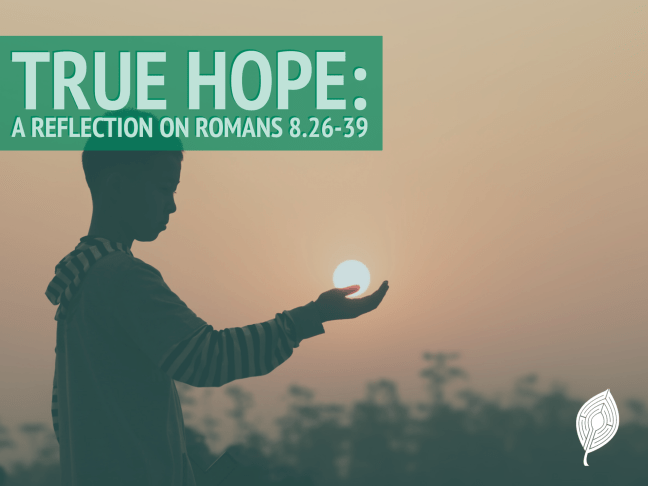
Once again, it’s hard to look at the news these days. The Canadian North is on fire, much of the United States and Europe are in the midst of a deadly heat wave, and dangerous storms are becoming daily occurrences throughout North America. It would seem our ecological chickens have come home to roost and our decades of collective inaction are leading us into a bleak and smoky future. On top of all this, the news is full of stories of unaffordable housing and a cost of living crisis, of underfunded hospitals at the breaking point, and a mental health crisis our society has neither the resources nor the will to resolve. In a situation like this, ‘hope’ is becoming a contentious word, almost as synonymous with inaction in many people’s minds as the expression ‘thoughts and prayers’. But this is not what hope is really about. True hope isn’t about simply hoping for the best, but about holding onto the possibility of a good future. And Christian hope is never dependent on politics or economics, but in our knowledge that any good future we may have is a future with God, in Christ. And neither of these should ever lead us to inaction, but rather should prompt us into action. As it happens, last week’s Epistle reading ended with something of a cliffhanger about hope. It read: For in hope we were saved. Now hope that is seen is not hope. For who hopes for what is seen? But if we hope for what we do not see, we wait for it with patience (Romans 8.24-25).
It was a bit of a strange place to end a reading, but thankfully today’s reading picks up right where it left off, and has a lot to say about the nature of Christian hope. It begins:
Likewise the Spirit helps us in our weakness; for we do not know how to pray as we ought, but that very Spirit intercedes with sighs too deep for words. And God, who searches the heart, knows what is the mind of the Spirit, because the Spirit intercedes for the saints according to the will of God. (8.26-27)
Christian hope begins and ends in God. No matter how it may feel, we are not alone in our efforts. Not only is the Spirit with us, but the Spirit gives us strength in our weakness and even prays in our stead when we don’t have the words or energy to do so ourselves.
We then come to one of the most inspiring — but also challenging — parts of the New Testament:
We know that all things work together for good for those who love God, who are called according to his purpose. For those whom he foreknew he also predestined to be conformed to the image of his Son, in order that he might be the firstborn within a large family. And those whom he predestined he also called; and those whom he called he also justified; and those whom he justified he also glorified. What then are we to say about these things? If God is for us, who is against us? He who did not withhold his own Son, but gave him up for all of us, will he not with him also give us everything else? Who will bring any charge against God’s elect? It is God who justifies. Who is to condemn? It is Christ Jesus, who died, yes, who was raised, who is at the right hand of God, who indeed intercedes for us. Who will separate us from the love of Christ? Will hardship, or distress, or persecution, or famine, or nakedness, or peril, or sword? …No, in all these things we are more than conquerors through him who loved us. For I am convinced that neither death, nor life, nor angels, nor rulers, nor things present, nor things to come, nor powers, nor height, nor depth, nor anything else in all creation, will be able to separate us from the love of God in Christ Jesus our Lord. (8.28-39)
These are powerful, hopeful words. But, it’s hard to read them and feel they have much real-world impact in a world that is full of troubles, pains, griefs, and sorrows. But again, Paul isn’t talking in ‘this world’ terms here. The famous Romans 8.28 about all things working for good is followed directly — and is defined — by Romans 8.29, which understands that ‘all things work together for good’ because they serve to make us like Jesus.* When we follow the way of Jesus. the Spirit will work in us to turn every circumstance into an opportunity to bring us further down that way. This is why, no matter what the world may throw at us, be it “hardship, distress, persecution, famine, nakedness, peril, or sword,” for those of us who are truly committed to the life of faith, nothing can separate us from God’s love. I’m reminded of the wonderful words of Julian of Norwich on this theme: “And all the woe and tribulation that [the devil] has caused [the faithful] will be changed into the increase of eternal joy. And all the pain and sorrow that he wanted to bring them will go forever with him into hell” (Revelations of Divine Love, chapter 13).
This is the nuance about Christian hope that so many Christians today seem to miss. It’s not a question of “Everything is going to be okay because God won’t let it be otherwise,” but “everything, even the things that aren’t okay, can be transfigured into Christlikeness by the power of the Holy Spirit.” And since Christ never dissociated or sat by idly, this type of hope is not demotivating or complacent, but rather spurs us all the more into action within our circumstances, both for our benefit and for that of those around us.
Thanks be to God.
–
* Note: I’m not going to comment on the language of predestination here, but if it’s interesting or concerning to you, please check out my post from last Summer, which explained how the New Testament uses the language (which isn’t how Calvinism has used it).
 Matthew Root
5 thoughts on “True Hope: A Reflection on Romans 8:26-39”