

One of the things that always strikes me about travel is how you both need to plan ahead and fully expect those plans to go awry. The start of my trip was a great example of this. When I was planning the trip, I knew I was meeting the friend with whom I was traveling in York, so I’d have a bit of a journey after getting off the plane in either London or Manchester. I dutifully looked up trains and saw there were lovely direct trains from Manchester to York that only took a couple hours and so I booked my ticket accordingly.
Imagine my surprise when the week before I was due to leave, I checked trains again and discovered that none of these direct trains were operating the day I needed to travel! Instead I’d have to cobble together the journey in bits and pieces. I knew I’d be okay and that it would work out. But I also knew I’d have to be up for an adventure and let the journey be what it would be. (On that front, I’m very glad I checked the trains before I left, so I had a few days to get my head around it. That would have been a very challenging thing to have to deal with upon landing (especially since I’d only gotten a couple of hours sleep on my red-eye flight)! As I joked with friends in the days before I left, I don’t have a spirit of adventure but given time to prepare, I can at least pretend to!) So, I just bought an any-time, any-route ticket and made the most of it. It turned out the route that ended up working best took me from Manchester Airport to Manchester Picadilly Station to Sheffield (on a local train) then at last to York. Ironically enough, there were banners all over Picadilly Station proudly proclaiming the wonderful, faster, and more efficient travel to York the track work causing the disruptions would allow in the future!
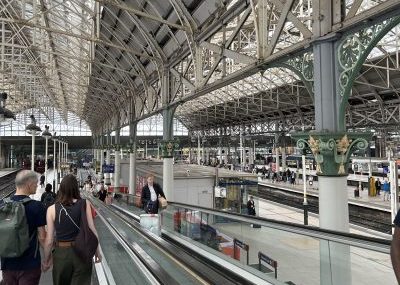
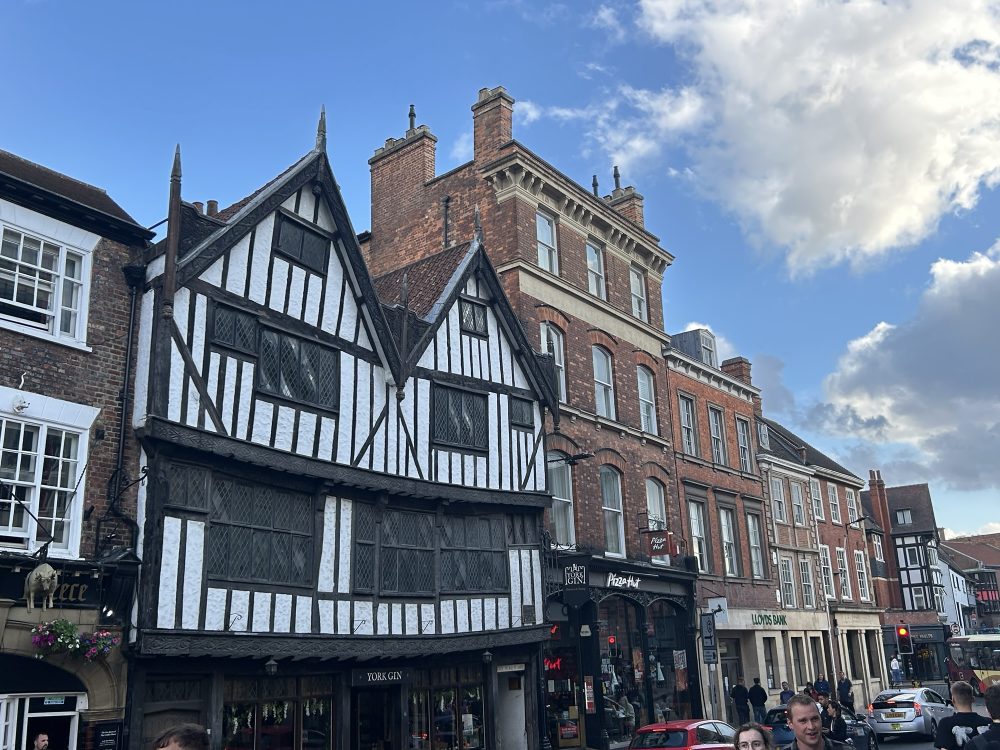
While all of the major points on the journey worked out, they were also all a bit glitchy: My train from Manchester to Sheffield changed platforms twice in the ten minutes I was at the station; someone set off an alarm on the train that the conductor couldn’t shut off, so it was blaring for most of the hour-plus journey; my train from Sheffield was running late, and then proceeded to lose still more time between Sheffield and Leeds. (I was also seated next to an American who was fuming the entire way about the delays.) Needless to say, I was exhausted and overstimulated by the time I arrived in York and could have kissed its ancient flagstones, after six trains and a transatlantic flight in sixteen hours.
Thinking about this journey through the lens of pilgrimage, a few things come to mind. First, it was a reminder that life never works in straight lines, from departure to destination, from A → B. Most commonly, it ends up being A → B → C → D → E, etc. And that’s not a glitch in the system, it’s just the way life works. There will always be something to mess up our plans. (The next day, a damaged bridge canceled all northbound trains from York; and my eventual train to the airport on my departure date was canceled due to someone on the tracks — if it’s not one thing, it will be another.) I think about this a lot in terms of how my life has turned out. If my twenty-year-old self, or even my thirty-year-old self, could see how everything has gone, I think I’d be pretty upset about it all. Nothing has gone according to plan and my life looks nothing like I hoped it would. But, with the givens of my life and personality, and in a changeable world filled with imperfect and sinful people, systems, and structures, that’s no surprise. And the life I’ve managed to build while all those plans were falling through has been a pretty good one.
Second, a big part of the anxiety of that day for me was simply stepping into the unknown. I knew that these rail systems are made to get people to their destinations and are pretty resilient after a couple hundred years of operation, so I knew there was no reason why I shouldn’t get to York some time that afternoon. But I also knew that navigating that system was largely outside my experience, and so my own user error could trip me up as much as anything else. At least I was traveling in a country that speaks my language so I could easily ask questions along the way. But again this is just like life: So much of maturity is stepping into those areas of the unknown, humbly accepting our ignorance and lack of mastery, and learning to make it work.
Third, sometimes the destination does matter, not perhaps in and of itself, but psychologically. There is something powerful about reaching a goal. And the more elusive it is, the more remote or challenging, or simply the more steps it takes to get there, the stronger that sense. In that way, diversions, detours, and delays can sometimes heighten our overall experience of what we’re seeking. And, the diversions and detours can allow us to see and experience more too if we don’t get stuck thinking of them as problems. For example, my train to Sheffield took me through the gorgeous Peak District — a place of incredible beauty I wouldn’t have seen otherwise, probably ever in my life!

But on the flip side, sometimes these diversions make something special impossible. Later in the trip, we were hoping to visit the cathedral in Hexham. While we got to the town and even drove past the cathedral, navigating the busy, narrow, winding medieval streets (with, being North American, everything in the driving experience being mirrored from what we know), we ended up giving up on parking and continued on our way without stopping. For my friend, who was driving, this was a real loss in his trip — a loss he needed to accept so that it wouldn’t cloud his day.
This ties into the main lesson here. All of these together involve an exercise in letting go. If I’d stayed stuck in my expectation that there would be a direct train, that would have taken up so much more emotional and psychological energy — as my angry seatmate on that last train demonstrated — that was far better used finding solutions and appreciating what I got to see along the way. Being in a foreign country is also always an exercise in letting go, of one’s sense of competence and basic sense of understanding the way things work. And sometimes, yes, we even need to let go of a destination in pilgrimage and in life.
While I would have loved to have had a simpler start to my trip, in hindsight I can appreciate it for forcing me into a more flexible, non-attached, mind-frame — a state that is not just useful on vacation or pilgrimage, but in life too. We never know what life will throw our way, but we can always expect the unexpected.
 Matthew Root
2 thoughts on “From A to B to C to D (or Best Laid Plans)”