
Last Summer, I did a short series that I called “Wisdom in Literature,” about how some of my favourite novels intersect with issues of faith. I thought it would be fun to pick that up again, with some of my favourite recent reads.
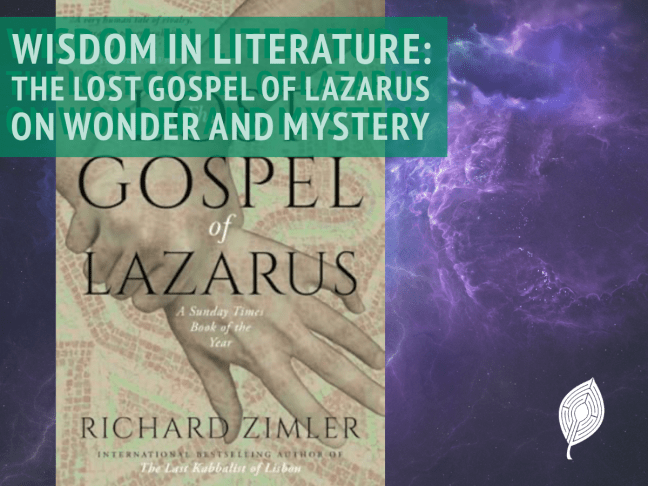
Today I’m going to talk about a recent Jewish retelling of the Jesus story: Richard Zimler’s The Lost Gospel of Lazarus (published in 2023 in North America, originally published in 2019 as The Gospel According to Lazarus). There are a lot of things I loved about this book. For one, it places Jesus — better than any other book I’ve read, fiction or non — into a realistic first-century Jewish context. This is a world filled with superstition, magic, and mysticism as much as it is with conspiracy, politics, and violence. Far too many pieces of Jesus literature just use a lot of a Semiticisms and expect that to do the work for them, but Zimler is far too knowledgeable and too strong of a writer to be that lazy, and it shows in the immersive world he builds here.
But the aspect of the book I’d like to touch on today is its sense of wonder before the mysteries of the world, life, and death. Here is just a sample of some of my favourite quotes from the book that touch on this idea:
- “Beware of men who see no mystery when they look at their reflection.”
- “We are all of us Adam and all of us Havvah [Eve], for the moment we realize we are alive — and separate from God — we become exiled from Eden.”
- “I consider what my mosaics would reveal about myself and the world if I had the courage to defy all expectations — if I could free what has been marked for sacrifice in my own self.”
- “Can it be that a small part of the Lord — exactly the size of a man — dies each time we do?”
- “In death, we never much resemble who we were in life, for all the mystery is gone.”
- “[T]he mysteries of the world sometimes appear to each of us in ways that others cannot see, and there are experiences that are not meant to be shared.”
- “[W]hen I feel my life has been wasted, he tells me to keep walking. He says that a journey well-travelled is a worthy — even glorious — accomplishment in itself.”
I could gush about each of these quotes for hours, but they touch powerfully on the wonder not just of life in general, but on every single life in particular. Each of us is unique, irreproducible, and therefore of infinite value. But amidst this gloriously high vision of humanity, it also recognizes the limitations and challenges of being human: the blindness to mystery and lack of self-awareness that afflicts so many, the universal recognition of separateness from God, and those pieces of our personalities and hearts we are too often asked to sacrifice on the altar of community and fitting in. All of these speak to alienation of one kind or another — an alienation from oneself that makes hard to see how our lives impact others, for good or for ill, an alienation from God that seeps into the deepest places of our hearts, and an alienation from the truest and fullest version ourselves.
But of course there is always hope. And this hope often manifests as wonder at the beauty and majesty of creation — including the vastness of space and the infinite depths of the heart — and of the God who placed eternity in our hearts.
May all our lives be filled with mystery, awe, and wonder. Amen!
 Matthew Root
One thought on “Wisdom IN Literature: The Lost Gospel of Lazarus on Wonder and Mystery”