
A former priest of mine once said that all ancient Christian heresies boiled down to an inability to assert that, in Jesus, God pooped.
What he meant by this is that as much as Christians have celebrated the Incarnation, the belief that God became fully human and through that experienced the full range of human life, there has always been something in Christianity that has never been truly comfortable with it, a dualism inherited from Greek philosophy that has never been fully excised. There is still a religious instinct that feels some aspects of human life are dirty and messy and therefore unfitting for God to have experienced. And so different groups have hedged on either Christ’s full divinity or his full humanity in order to ‘protect’ God from such indignities. This was certainly true back in the day with the ancient heresies, but remains true in the twenty-first century, with many Christians asserting the Incarnation but not quite trusting it because they are profoundly suspicious of embodied life.
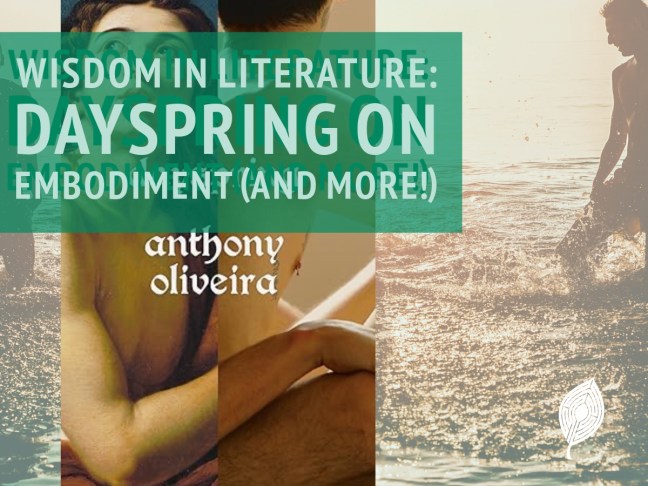
Into this situation comes Anthony Oliveira’s Dayspring (2024), one of my absolute favourite books of the year and, probably, ever. Now before I go into it I have to flag that this book — and even my description of it — won’t be for everyone. And that’s okay. There are wonderful books that are universal and then there are wonderful books that simply won’t speak to all audiences. This book’s great power, but also its audience-limiting factor, is that it’s a Jesus novel, and one that places Jesus in a sexual relationship with another man. It’s a big swing and one that could easily not have worked for me. A lot of such ‘creative’ play with canonical figures just seems designed to shock or make a statement. I’ve not finished more than one such Jesus novel! But they can also really work well, provided the twist serves a purpose. And that’s why this one is so successful. Yes, it has Jesus in a sexual relationship with another man, but it’s never done in a way designed either to shock or to titillate. Rather, Jesus is a sexual being here for the same reason as he delights in making fart bubbles in the bath: because he delights in his embodied existence. In other words, this poetic, unabashedly queer, novel is one of the most profound reflections on the Incarnation I’ve encountered: “And the Word became flesh: coarse hair, crooked smile, the taste of salt on his clavicle.” This is God not just becoming human but becoming a man, a human person. And if part of that is the sticky, smelly, pleasurable realities of sex, then so be it.
Interspersed throughout the more-or-less recognizable Gospel narrative are quotations from mystics throughout the centuries who have described their relationship with Christ in erotic terms. This is really effective because it again pushes back against the dualist suggestion that desire and pleasure are bad things, while also leaning into the personal charisma this figure Jesus had not only in his earthly life but to the present day.
Beyond these playful, speculative, but theologically important forays into a poetic rejection of dualism in Christianity, the book also soars for the way it brings Jesus to life. It includes all of Jesus’ greatest hits, but put into a believable contemporary mode of speaking, while capturing the humour and spirit of the original. For example, when the religious authorities try to trap him about belief in the Resurrection of the Dead with the absurd question about which brother would be the legitimate husband of a woman who had married all of them, this Jesus responds bluntly, “Please do not ask me stupid fucking questions.” Or, in a particularly poignant comment for our present moment in history, Jesus’ comment warning potential disciples of the risks of following him is turned into a more universal statement of the sinfulness of human social and economic structures — but in a way that still feels true to the spirit of the original:
the fox has a den
and
the bird has a nest
only humans go homeless.
Elsewhere, Jesus’ teachings are summarized in new verses that are worthy of the Gospels:
The body is never the index of sin
aesthetics are never ethics
and illness is never iniquity.
Or, in a powerful move, slogans from ACT UP HIV/AIDS activists are given the red-letter treatment (literally — the text of the first edition puts Jesus’ words in red): “An army of lovers cannot lose.”
Wherever these liberties with Jesus’ words and teachings are taken, they are done so poignantly, beautifully, and I would say, faithfully. The Jesus of Dayspring calls us out and up into lives of greater faithfulness to God and each other, just as the Jesus of the Gospels does. It’s a Jesus that leaps off the page and confronts us with the world’s injustice and iniquity while still embracing that world for all the joy it offers.
And so, while yes, the core relationship at the heart of Dayspring will make it anathema to many potential readers, I for one am so glad it exists for everything that it’s trying to do. This is far from ‘erotic Jesus fan-fiction’ but is instead a profoundly theological, mystical and poetic work that leans into the doctrine of the Incarnation with as much wonder, joy, and beauty as it can.
 Matthew Root