
The last century has seen an incredible shift in the world, away from a society in which most people lived and died where they were born to one in which few people do so. This has led to a world where we have many more options and opportunities, but also one in which fewer and fewer people have life-long relationships or any sense of stability and place. This is creating problems both for us as people (the loneliness epidemic is very real) and for the places we live in, which are treated as being as disposable as dinner scraps. It seems to me that staying and leaving are both important and yet seem far more difficult to balance than most of the so-called positive-positive polarities I’ve written about here over the years. And the thing is both impulses run deep in the human spirit. We long to go and find our place in the world, yet we long to be known. Both are kinds of belonging, and very few of us have the privilege of discovering both.
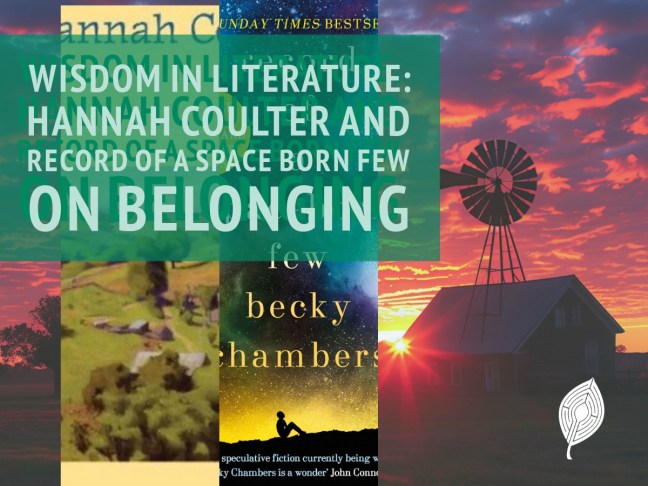
Today I’d like to talk about two novels that deal with these themes in different ways. Wendell Berry’s Hannah Coulter (2004) is a novel about the hollowing out of rural communities and looks back fondly on the time when leaving meant moving to the next town over, or going further afield but always with the aim of coming home again. Becky Chambers’ Record of a Spaceborn Few (2018) imagines the different lives of humans living in diaspora communities following the destruction of Earth, and through them explores the universality of human longing for a life other than what we have.
The protagonist and title character of Hannah Coulter is a young woman who has experienced a lot of loss. Raised by a distant father and hateful stepmother, she escapes with the help of her grandmother to the next town over, only to be widowed in World War II, and only slowly comes to realize happiness is possible again. She works hard on the farm and is satisfied with the life she has: “We had, you could say, everything but money — Grandmam and I did, anyhow. We had each other and our work, and not much time to think of what we didn’t have.”
She is committed to seeing her kids have he possibility of higher education, but is devastated when they don’t return home again after graduation:
The big idea of education, from first to last, is the idea of a better place. Not a better place where you are, because you want it to be better and have been to school and learned to make it better, but a better place somewhere else. In order to move up, you have got to move on. I didn’t see this at first. And for a while after I knew it, I pretended I didn’t. I didn’t want it to be true.
Looking back on her life, she reflects:
Most people now are looking for a better place, which means that a lot of them will end up in a worse one. I think this is what Nathan [her second husband] learned from his time in the army and the war. He saw a lot of places, and he came home. I think he gave up the idea that there is a better place somewhere else.
There is no “better place” than this, not in this world. And it is by the place we’ve got, and our love for it and our keeping of it, that this world is joined to Heaven. . . .
The life she’s talking about is one that is defined by place, by rootedness, connection, and belonging. It’s a community built on shared history, on knowing your neighbours because your grandparents knew their grandparents. And it’s community based on shared labour, embodying the value of ‘many hands make light work’. Think barn-raisings or quilting bees or canning parties. And there’s joy and belonging in all these things. And it’s beautiful. Hannah concludes:
“You mustn’t wish for another life. You mustn’t want to be somebody else. What you must do is this: “Rejoice evermore. Pray without ceasing. In everything give thanks.” I am not all the way capable of so much, but those are the right instructions.”
There’s a lot of truth here. As the saying goes, ‘Wherever you go, there you are’ — meaning that more often than not we bring our problems with us no matter where we go. If we’re dissatisfied with life, it’s not because our life is bad, but because life is inherently frustrating and disappointing. There’s no way around it. (This is, as it happens, the central tenet of Buddhism.) It’s not for nothing that stability was a primary virtue in ancient monasticism. Learning to love and accept life means learning to love and accept the difficulties of where we are. So there is a lot of wisdom in the perspective of Hannah Coulter.
And yet we know that this life isn’t for everyone. It’s easy to romanticize small town life (something which the Hallmark Channel has famously capitalized on!). Whether the soul with wanderlust, always wondering what’s over the next ridge, or the misfit who despite their best efforts is unable to fit in where they’re ‘supposed to,’ or the outsider who is shunned by the community, all the blessings of that rooted, stable life were never for everyone. This is to say nothing about those for whom staying put would mean subjecting themselves to a life of abuse. So as much wisdom as I see in Hannah Coulter, it’s a one-sided, partial wisdom.
The human lives described by Becky Chambers in Record of a Spaceborn Few couldn’t be more different, but it explores some similar themes. Earth is but a distant memory and the human remnant is increasingly scattered among different alien worlds, except for those committed to preserving the way of life established in the fleet of ships on which they had originally fled their dying world. Here we see the same tensions play out: the legitimate needs of the community for its own survival and the importance of tradition, set up against the legitimate needs of the individual to explore, to change, and to find a place where one fits. We meet Tessa, a wife and mother aboard a traditional Fleet ship who chose to stay home when her brother left to explore but is questioning that decision as midlife approaches. We meet Kip, a young apprentice, who feels a deep need for change but doesn’t know where to find it. And, we meet Sawyer, raised outside the Fleet but who decides to visit to see if he can find a place for himself there. All of these characters (and others) experience a longing for ‘more’, for that ‘better place’ Hannah Coulter dismissed as an impossibility. The answer the book proposes is not just to stay put and make the best of things, but nor is it to set off without looking back, but something more nuanced: “We’re meant to go. And we’re meant to stay. Stay and go, each as much as the other. It’s not all or nothing anymore.” And:
The only way to really appreciate your way is to compare it to somebody else’s way. Figure out what you love, specifically. In detail. Figure out what you want to keep. Figure out what you want to change. Otherwise, it’s not love. It’s clinging to the familiar — to the comfortable — and that’s a dangerous thing for us short-term thinkers to do. If you stay, stay because you want to, because you’ve found something here worth embodying, because you believe in it. Otherwise…well, there’s no point in being here at all, is there?
It also recognizes that, just like our bodies’ craving for sugary and fatty foods even when we’re well-fed, our hearts’ longing for more doesn’t always point us in the right direction. When asked the question of what he really wanted in life, one character realizes that “The problem was that what he wanted, more than anything, was to fuck someone or fight something, and he knew – from experience, now – that if given the opportunity, he’d be too scared to do either. Cool. Real cool.” Again, sometimes we’re dissatisfied because that’s just the way life is. Even beyond such minor whims, there’s also the very real danger of never settling down to anything or anyone, just spending life going from one ‘better place’ to the next. This hinders not only our growth, but also our ability to contribute to the places we’re in. It’s impossible to be faithful when all of our relationships are superficial and temporary! I think this is a big problem in our present society: So many people are so focused on novelty as a value that they don’t see the value in stability and commitment, in investing in something, someplace, or someone. But as Chambers succinctly puts it, “If trying something new was valid, then keeping something old was, too.” And, “Many — not all, but many — leave here and are too eager to change their story. […] But I worry about those who think adopting someone else’s story means abandoning their own.”
I don’t think there’s a perfect solution to living out this positive-positive polarity of staying and leaving. For most of us the best we can probably hope for is the discernment to know when to stay and when to go, and to develop a strong inner life that can support us through that feeling of ‘unsatisfactoriness’ that is just part and parcel with being human.
 Matthew Root