
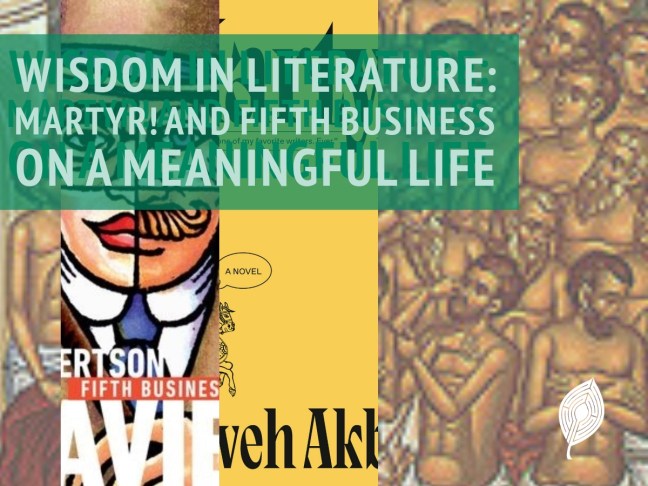
There are few more fundamental questions for the human spirit than “What makes a life meaningful?” In big and small ways, it’s a question most pieces of art, whether literary, musical, theatrical, or visual, address. Today I’d like to talk about two novels that tackle the question head on: Robertson Davies’ 1970 masterpiece Fifth Business, and Kaveh Akbar’s powerful 2024 release, Martyr!
Fifth Business is framed as newly retired teacher Dunstan Ramsay’s response to a glowing but ultimately dismissive account of his life. Starting from his childhood in a small town in Southwestern Ontario around the turn of the last century, he traces the intersections of his life with various remarkable men and women, including the famous, the rich, the beautiful, the monstrous, the ostracized and forgotten, sinners and saints. He makes the case that, not only did he live his life, but that much depended upon it.
The idea the book uses to describe the meaning of Ramsay’s life is “fifth business,” a term the book purports to be from the theatre, but which Davies later admitted he invented. In the crucial passage, Liesl, a new lover who challenges him in many ways, calls Ramsay out for acting like a bit part in other people’s lives, and warns him, “This is the revenge of the unlived life, Ramsay. Suddenly it makes a fool of you.” (This calls back to an earlier warning given to Ramsay: “If you don’t hurry up and let life know what you want, life will damned soon show you what you’ll get.”) Liesl’s speech reaches its climax when she introduces the theme of “fifth business”:
Who are you? Where do you fit into poetry and myth? Do you know who I think you are, Ramsay? I think you are Fifth Business. You don’t know what that is? Well, in opera in a permanent company of the kind we keep up in Europe you must have a prima donna — always a soprano, always the heroine, often a fool; and a tenor who always plays the lover to her; and then you must have a contralto, who is a rival to the soprano, or a sorceress or something; and a basso, who is the villain or the rival or whatever threatens the tenor.
“So far, so good. But you cannot make a plot work without another man, and he is usually a baritone, and he is called in the profession Fifth Business, because he is the odd man out, the person who has no opposite of the other sex. And you must have Fifth Business because he is the one who knows the secret of the hero’s birth, or comes to the assistance of the heroine when she thinks all is lost, or keeps the hermitess in her cell, or may even be the cause of somebody’s death if that is part of the plot. The prima donna and the tenor, the contralto and the basso, get all the best music and do all the spectacular things, but you cannot manage the plot without Fifth Business! It is not spectacular, but it is a good line of work, I can tell you, and those who play it sometimes have a career that outlasts the golden voices. Are you Fifth Business? You had better find out.
It’s less that Ramsay hasn’t been living a meaningful life until this point, but that he hasn’t realized it — minimizing his professional accomplishments, devaluing his interests, and discounting the impact he’s had in his personal relationships. He hasn’t been merely a bit character at all, but has followed his interests to the ends of the earth, published books, seen the world, and developed longstanding, if conflicted, relationships. He has been the main character of his life — he just needs to wake up to that fact.
Cyrus, the main character in Martyr! is similarly dealing with feeling small in the world. But for him this isn’t the result of the self-deprecation Ramsay experienced, which stemmed from his extreme WASPy upbringing in small-town Ontario. Rather, it’s due to his growing up queer, Muslim, and Iranian in the American Midwest and haunted by his mother’s death in the Iran Air Flight 655 incident. As he grows up, be becomes an addict and embraces other self-destructive behaviours, to the point of contemplating suicide. But he’s made to realize that this desire for self-immolation is really not all that different from those extremists he loathes who seek to make their lives meaningful through martyrdom:
If the mortal sin of the suicide is greed, to hoard stillness and calm for yourself while dispersing your riotous internal pain among all those who survive you, then the mortal sin of the martyr must be pride, the vanity, the hubris to believe not only that your death could mean more than your living, but that your death could mean more than death itself—which, because it is inevitable, means nothing.
If Liesl’s speech is the narrative crux of Fifth Business, here it’s a recounting of a story the book calls “some old-school Muslim fairy tale.” In it, Satan is shown God’s new favourite creation, Adam, and is profoundly unimpressed. He goes so far as to jump down Adam’s throat, passing through all the way out the other end:
And when he gets out, Satan’s laughing and laughing. Rolling around. He passes all the way through the first man and he’s rolling around laughing, in tears, and he says to God, ‘This is what you’ve made? He’s all empty! All hollow!’ He can’t believe his luck. How easy his job is going to be. Humans are just a long emptiness waiting to be filled.
Later, on this theme of essential human emptiness, he complains:
Eight of the ten commandments are about what thou shalt not. But you can live a whole life not doing any of that stuff and still avoid doing any good. That’s the whole crisis. The rot at the root of everything. The belief that goodness is built on a constructed absence, not-doing. That belief corrupts everything, has everyone with any power sitting on their hands.
Cyrus’s quest doesn’t have a clear resolution, but the final image we’re left with suggests, the answer is more likely to rest in the quieter things of daily life, like sitting on a park bench or spending time with a friend, than in any grand gesture.
So in their very different ways, both of these characters are facing the same problem of how to live in a way that is meaningful. It’s a question that has no ready-made answers, but is one we all have to answer for ourselves. But I’m glad for authors like Davies and Akbar and characters like Ramsay and Cyrus to help us sort it through. I’ll give Akbar a well-deserved final word today: “An alphabet, like a life, is a finite set of shapes. With it, one can produce almost anything.”
 Matthew Root