
Back in 2018, I undertook an exercise to develop a hermeneutical method that incorporated elements and insights of Integral theory. I took the story of Elijah’s flight from Jezebel and subsequent encounter with God (1 Kings 19) as my sample text for this series.
- The Written Word (Toward an Integral Hermeneutic: Introduction)
- Growth-Oriented
- Holistic
- Integrating
- Adding Complexity
- Sacred Practices: Integral Hermeneutic
The model that emerged can be summarized in the figure below:
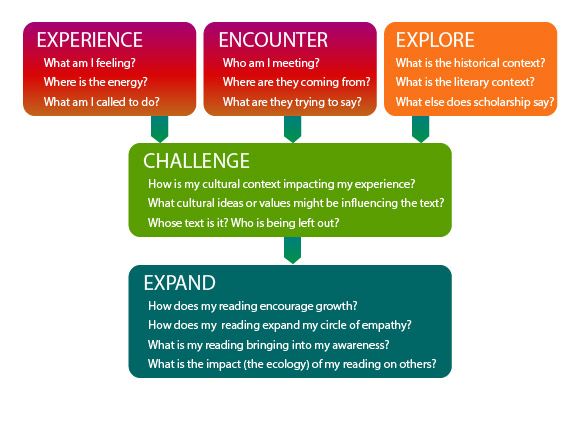
Then, in the Spring of 2025, as part of my broader ‘Reading the Bible Initiative’ (see previous series on the history of biblical interpretation and biblical genres), I took a fresh look at the ‘big questions’ that guide my methodology:
Experience
Encounter
Explore
- What is the historical and cultural context?
- What is the literary context?
- What else do the Scriptures say about this?
- What do traditional readings of the text have to say about it? (and about the tradition?)
Challenge
Expand
- How does my interpretation encourage growth?
- How does my interpretation encourage me to love? (Or, How does it expand my circle of empathy?)
- What is the impact of my reading on others? (Or, what fruit does it bear in the world?)
Since developing the model, I have used it here on the blog to explore the following texts:
- Genesis 1-11 (section study)
- Abraham and the Three Visitors
- Sarah and Hagar
- The Sacrifice of Isaac
- Jacob wrestling with God
- Jehu’s Rebellion
- The Parables of Jesus in Matthew & Luke
- Romans 1.18-32
- Romans 3.21-26
- Romans 5.12-21
- Ephesians (full book study)
- Hebrews 10.11-2
 Matthew Root